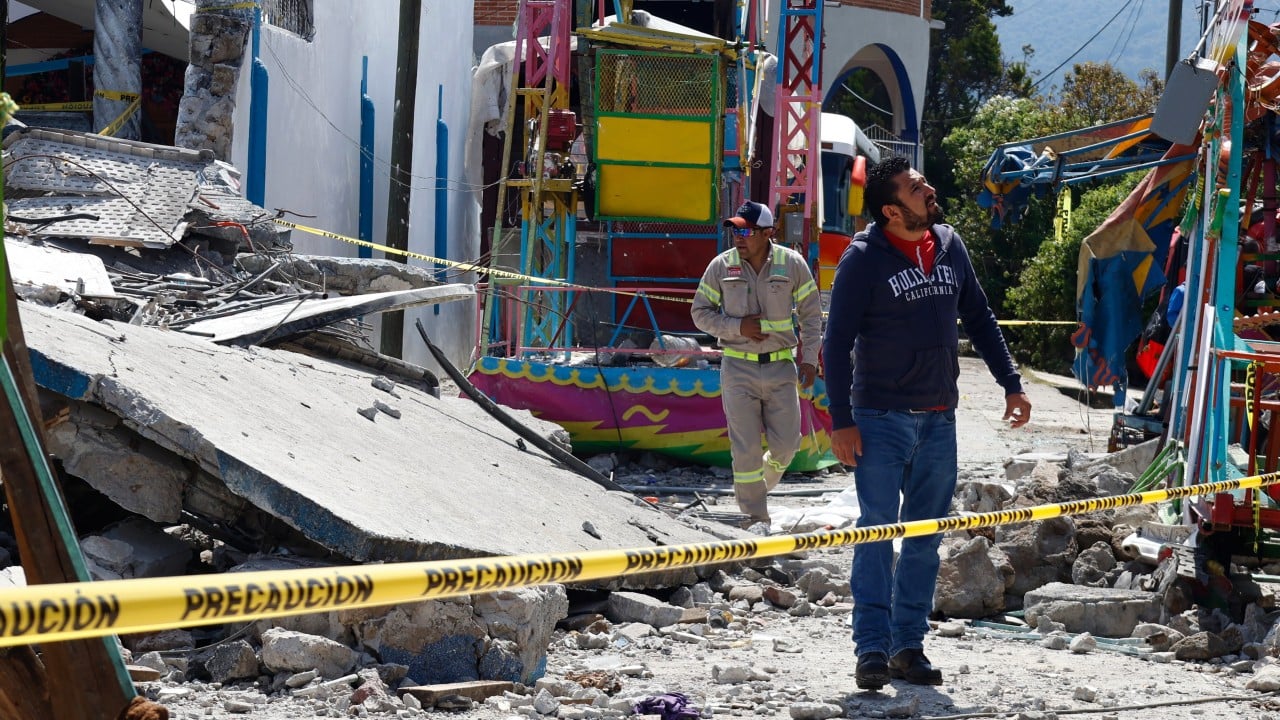
Ten fatalities and sixty-four hospitalizations resulting from a localized pyrotechnic detonation during a patron saint festival in Santa María Canchesdá, Temascalcingo, expose systemic vulnerabilities in event-adjacent hazardous material management. When pyrotechnic inventory intended for public display is co-located within community infrastructure such as parish storage rooms, the resulting kinetic and thermal output routinely exceeds the structural load-bearing capacity of adjacent buildings.
The catastrophic partial collapse of the Nuestra Señora de la Luz parish structure highlights a fundamental breakdown in risk mitigation protocols. To deconstruct how routine religious celebrations transform into mass-casualty events, analysts must evaluate the tripartite failure model governing public pyrotechnics: inventory density, structural containment, and spatial separation thresholds.
The Tripartite Failure Model of Public Pyrotechnics
Evaluating high-consequence accidents requires moving past surface-level incident reporting to examine the underlying physical and administrative variables. Three distinct vectors drive events like the Temascalcingo disaster.
1. Unregulated Inventory Density and Storage Failures
Commercial and artisanal fireworks rely on black powder, flash powder, and perchlorate-based chemical compositions. These compounds possess high mass-energy densities and low activation energy thresholds. Storing these materials inside multi-use civic or religious rooms eliminates critical safety buffers.
When bulk quantities of pyrotechnics occupy an unrated interior space, ambient temperature fluctuations, electrical faults, or stray ignition sources encounter zero containment resistance. The confinement offered by standard masonry or brick walls transforms deflagration into detonation. Instead of venting safely into the open air, expanding gases build internal pressure until the structural enclosure fails violently, projecting high-velocity shrapnel and heavy masonry fragments into crowds.
2. Spatial Deficit and Crowd Proximity
Traditional community festivals prioritize cultural immersion and high-density congregation. Crowd placement directly adjacent to storage zones or staging areas introduces an unacceptable casualty multiplier.
During the festival in the State of Mexico, attendees gathered immediately outside the parish grounds to observe pre-celebration displays. Traditional safety radiuses—which dictate clear zones based on shell caliber and net explosive weight—are routinely ignored or compressed due to spatial limitations inherent in historic town centers. When the storage cache breached, the distance between the energy release point and the human perimeter was measured in single-digit meters, neutralizing human reaction time and eliminating viable evacuation corridors.
3. Regulatory Enforcement Deficits
A structural analysis of Mexican pyrotechnic incidents reveals a persistent enforcement gap between federal oversight and municipal execution. While agencies such as the Secretariat of National Defense maintain rigorous legal frameworks governing the manufacture, transport, and storage of explosives, local community events frequently bypass these protocols. Artisanal producers often supply rural parishes directly, operating outside formal chain-of-custody tracking. Without mandatory on-site inspections by certified ordnance handlers, dangerous storage practices persist until a catastrophic failure forces retroactive intervention.
The Mechanics of Kinetic and Thermal Trauma
The medical footprint resulting from the Temascalcingo blast underscores the complex injury patterns generated by enclosed explosive events. Emergency medical services triage data indicates a distribution of trauma spanning three distinct categories: primary, secondary, and tertiary blast effects.
Primary blast injuries stem directly from the high-pressure shock wave interacting with air-filled organ systems. While secondary blast injuries—caused by flying shrapnel, glass, and fractured masonry—account for the majority of superficial lacerations and traumatic wounds, tertiary injuries prove lethal.
Tertiary trauma occurs when the physical displacement of the body by the blast wind results in high-speed impact with stationary structures. Furthermore, the confinement of the blast within a semi-enclosed parish courtyard produced prolonged thermal radiation, yielding severe first-, second-, and third-degree burn profiles among survivors. The presence of children and clergy near the immediate detonation zone intensified the physiological severity, as pediatric populations exhibit significantly lower tolerance thresholds for blast-induced barotrauma and thermal surface area loss.
Systemic Interventions Required to Prevent Recurrence
Mitigating future mass-casualty incidents during traditional celebrations requires replacing voluntary compliance models with rigid operational controls. Municipalities must decouple pyrotechnic staging from active places of worship and high-density pedestrian zones.
Mandatory remote storage containers, certified earth-mounded magazines, and daily transport of only the exact net explosive weight required for a single performance will eliminate bulk inventory accumulation on festival grounds. Establishing mandatory exclusion perimeters enforced by civil protection authorities will decouple civilian congregation areas from potential blast vectors, ensuring that cultural traditions proceed without catastrophic structural compromise.
Enforce mandatory independent third-party safety audits for all municipal and religious festival pyrotechnic inventories prior to event commencement.