Global supply chains rely on a highly distributed workforce operating within volatile chokepoints, exposing systemic vulnerabilities when unilateral enforcement actions clash with global labor dependencies. The death of three Indian mariners aboard the oil tanker MT Settebello during a United States military enforcement strike in the Gulf of Oman exposes a structural friction point in the current geopolitical order: the intersection of US secondary economic sanctions, maritime security enforcement, and India's dominant share of global seafaring labor.
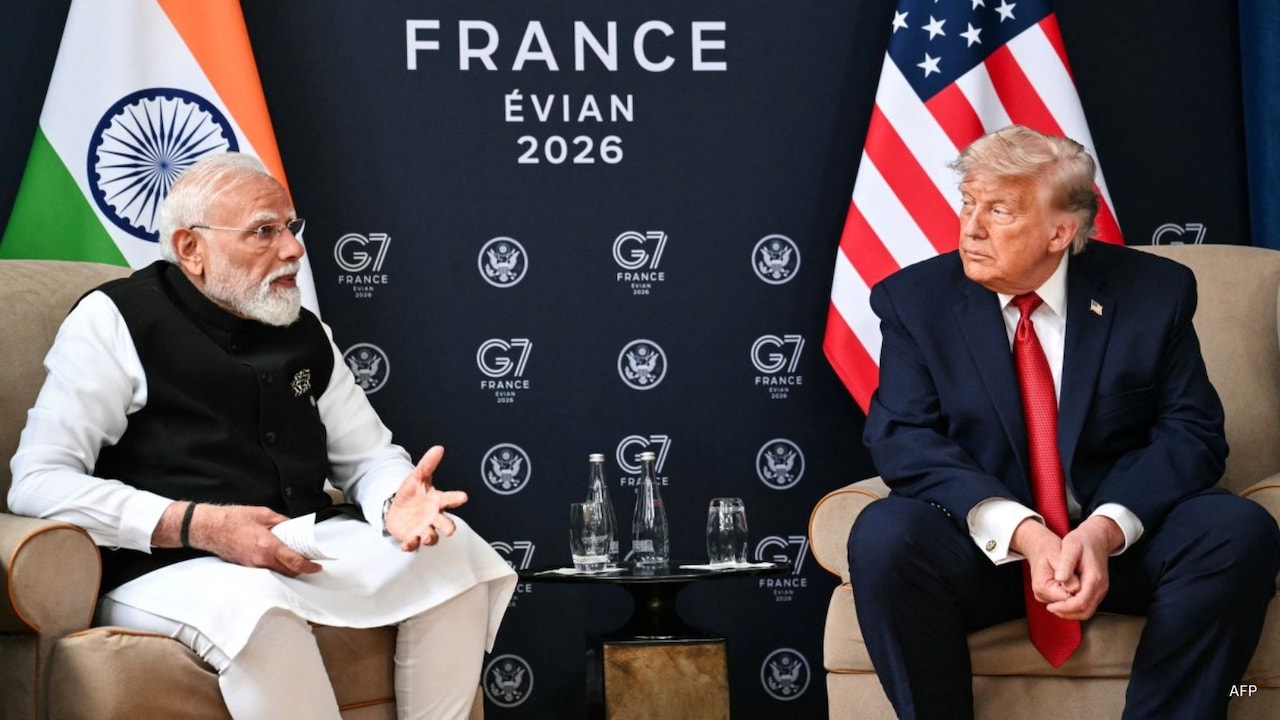
The incident, which occurred just days before the G7 summit in Évian, France, prompted an direct diplomatic intervention from Indian Prime Minister Narendra Modi during bilateral talks with US President Donald Trump. While public media coverage frames this interaction around personal diplomacy and bilateral platitudes, a rigorous structural analysis reveals a deeper, structural cost function governing maritime trade, state sovereignty, and international law.
The Three Pillars of Maritime Labor Vulnerability
To understand why a US military strike on a Palau-flagged vessel carrying Iranian crude precipitates a major diplomatic friction point between Washington and New Delhi, one must map the three structural realities of modern commercial shipping.
- Labor Demographics and Exposure: India supplies approximately 10% of the global seafaring workforce. This high concentration means that irrespective of a vessel's flag state, ownership structure, or cargo origin, the operational crew is statistically highly likely to feature Indian nationals. Consequently, any kinetic or enforcement action taken against the global merchant fleet carries a disproportionate risk of inflicting Indian civilian casualties.
- The Flag of Convenience Arbitrage: Under international maritime law, commercial vessels frequently operate under Flags of Convenience (FoC)—such as Panama, Liberia, or Palau. This decoupling of vessel nationality from crew nationality and ownership creates a fragmented legal architecture. When the US military executes kinetic enforcement against non-compliant vessels, it acts against a sovereign foreign flag, yet the physical human costs are borne by third-party labor supply states like India.
- Chokepoint Concentration: Commercial shipping routes dictate that energy architectures pass through highly constrained geographic bottlenecks, most notably the Strait of Hormuz. When unilateral enforcement zones overlap with dense shipping lanes, commercial crews are structurally forced into high-risk vectors where the margins for operational error or miscommunication are non-existent.
The Friction Vectors in US Sanctions Enforcement
The kinetic intervention against the MT Settebello, alongside actions involving the MT Marivex and MT Jalveer, highlights a fundamental breakdown in operational signaling. The US military maintains that these vessels failed to comply with active maritime directions and were operating in violation of US restrictions regarding Iranian energy exports.
This creates a severe operational hazard for third-party crews. Commercial mariners do not typically possess ownership stakes or decision-making agency regarding port destinations, corporate compliance, or cargo verification; they execute navigation contracts on behalf of ship management companies. When a state employs kinetic assets to enforce secondary economic sanctions, the enforcement mechanism transitions from financial penalties to physical hazards. The crew becomes an inadvertent shield for illicit or non-compliant trade structures, generating a high-stakes failure state where maritime workers pay the price for corporate non-compliance.
The G7 Diplomatic Leverage Play
During the G7 outreach sessions, Prime Minister Modi’s calculated public raising of seafarers' safety represented a strategic attempt to hardcode labor protections into the impending US-Iran diplomatic framework. The timing of the intervention exploited a narrow window of high bilateral leverage.
[US Sanctions Enforcement] ---> [Kinetic Interdiction] ---> [Indian Mariner Casualties]
                                                                     |
[US-Iran Peace Agreement]  <--- [Modi's G7 Intervention] <--- [Public Diplomatic Friction]
By explicitly linking the freedom of navigation in the Strait of Hormuz to the physical safety of Indian crews, New Delhi shifted the baseline from an insular security discussion to an economic interdependence framework. This logic forces Washington to calculate the diplomatic friction generated with its primary strategic partner in the Indo-Pacific against the marginal gains of aggressive, mid-sea kinetic interdictions.
President Trump’s characterization of seafaring as a "rough profession" and his subsequent rhetorical pivot to mutual defense assurances underscore an asymmetry in strategic priorities. While Washington views the incident through the lens of a localized, high-risk operational environment, New Delhi views it as a systemic failure of a security partner to differentiate between illicit trade operators and innocent contracted labor.
Structural Limitations of the Bilateral Resolution
The declaration that the United States would defend India in the event of an external conflict functions as an effective tool for diplomatic de-escalation, but it does not address the underlying systemic vulnerabilities. Two structural bottlenecks prevent a permanent solution under the current framework:
- The Scope Incongruvention: A generalized commitment to sovereign defense does not apply to non-war military operations, such as sanctions enforcement, anti-smuggling operations, or unilateral interdictions in international waters.
- The Jurisdictional Void: Because commercial crews operate on vessels registered to foreign flags, India lacks direct legal jurisdiction over the physical site of the incident, meaning it must rely entirely on retroactive diplomatic protests and the summoning of foreign emissaries rather than systemic legal remedies.
Strategic Capital Alignment
To mitigate these risks moving forward, state actors must transition away from reactive diplomacy and toward a standardized operational protocol. India will likely pressure the United States to establish a formalized "Civilian Mariner Non-Targeting Protocol" within its maritime enforcement command architecture. This mechanism would require verifying crew demographics and establishing multi-layered, non-kinetic hailing procedures before executing physical interdictions on commercial vessels. If Washington fails to integrate these labor safeguards into its regional enforcement models, the recurring human cost of secondary sanctions will continue to inject volatility into global maritime trade routes, threatening the stability of the broader bilateral alliance.