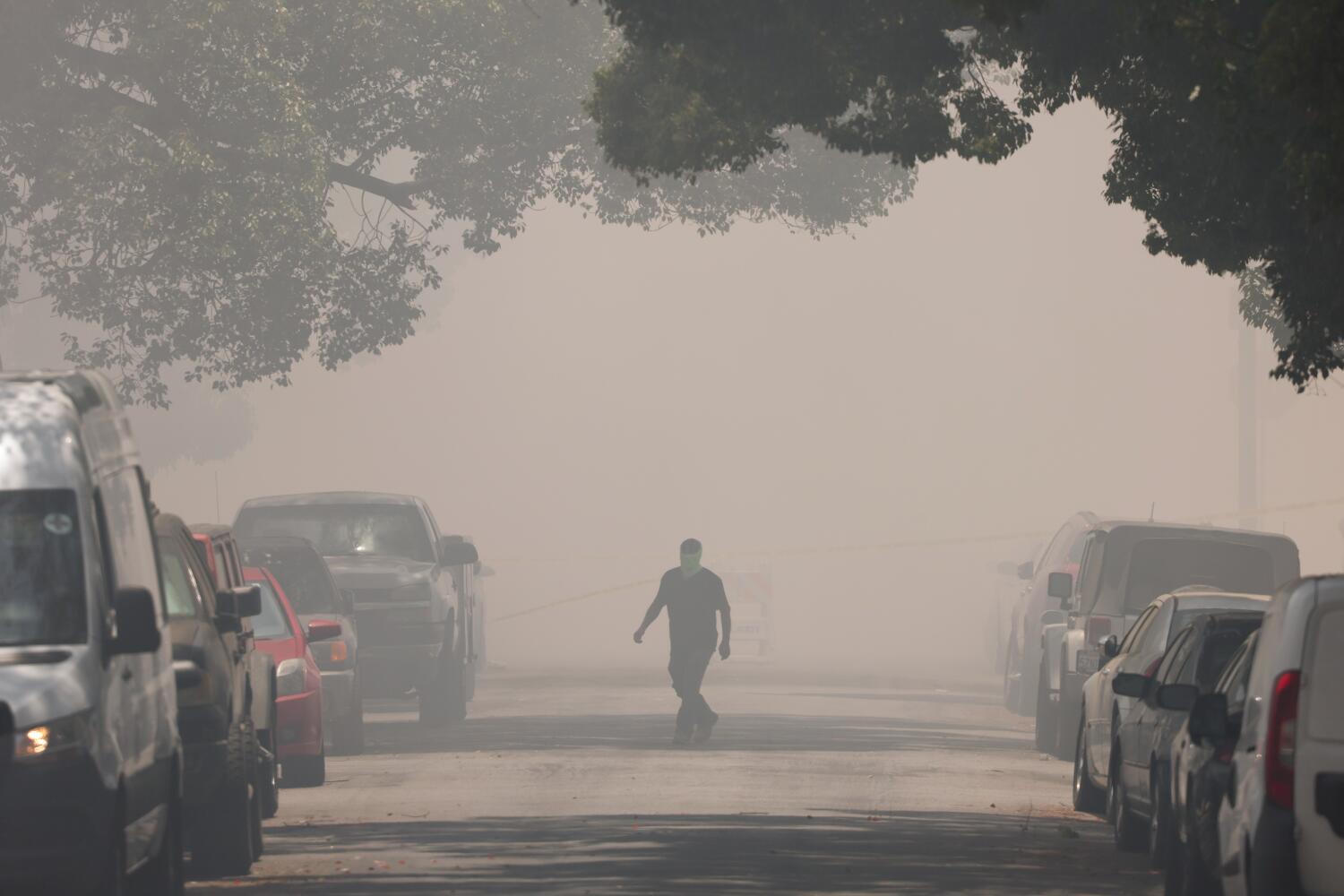
The surge in localized clinical presentations for acute respiratory distress following the June 2026 industrial fire in Boyle Heights represents a structural failure in municipal containment and acute risk communication, rather than a standard, predictable baseline fluctuation in municipal air quality. When a 500,000-square-foot cold-storage warehouse burns for over a week, treating the resulting emergency as a standard atmospheric variance ignores the specific chemical inputs that differentiate industrial plumes from standard urban air pollution. Quantifying this crisis requires shifting the analytical framework away from generic ambient Air Quality Index (AQI) metrics toward a precise evaluation of localized toxicity, micro-spatial wind patterns, and the subsequent downstream burden placed on municipal healthcare systems.
Standard AQI measurements are built to track macro-level concentrations of regulated criteria pollutants like regional particulate matter ($PM_{2.5}$) over broad geographic areas. They fundamentally fail to evaluate the immediate, compounding health risks presented by a hyper-concentrated, unregulated industrial chemical cocktail. To understand the true mechanics of the surge in hospital visits during the Boyle Heights incident, the disaster must be deconstructed through a rigorous, multi-tiered framework.
The Three Pillars of Toxic Industrial Plume Dynamics
Evaluating the public health impact of the Lineage Logistics facility fire requires isolated analysis of three distinct vectors. These vectors dictate the severity, duration, and geographic distribution of the physiological harm.
                  +----------------------------------+
                  |    TOXIC INDUSTRIAL PLUME        |
                  +----------------------------------+
                                   |
         +-------------------------+-------------------------+
         |                         |                         |
         v                         v                         v
+-----------------+       +-----------------+       +-----------------+
| PILLAR 1:       |       | PILLAR 2:       |       | PILLAR 3:       |
| Pyrolytic       |       | Structural      |       | Micro-Spatial   |
| Composition     |       | Containment     |       | Orographic      |
| Complexity      |       | Insulated Traps |       | Topography      |
+-----------------+       +-----------------+       +-----------------+
Pillar 1: Pyrolytic Composition Complexity
The toxicity of a plume is determined by the specific materials undergoing incomplete combustion (pyrolysis). In standard structural or vehicular fires, wood, drywall, and basic synthetics dictate the smoke profile. The Boyle Heights facility presented a high-density matrix of complex industrial components:
- Commercial Photovoltaic Arrays: The rooftop featured a massive solar installation. The combustion of solar modules, wiring harnesses, and inverters releases toxic metalloids, volatile organic compounds (VOCs), and heavy metals.
- Industrial Fluoropolymers: Combustion of high-capacity lithium-ion batteries from material handling equipment (such as electric forklifts) was confirmed via the early detection of hydrogen fluoride ($HF$) gas. Hydrogen fluoride is a severe systemic toxin that causes immediate respiratory tract corrosion and delayed, life-threatening cardiac arrhythmias via severe calcium depletion.
- Anhydrous Ammonia ($NH_3$): The facility contained over 12,000 pounds of anhydrous ammonia utilized for high-scale refrigeration. While containment lines largely held, periodic breaches and thermal degradation of localized refrigeration infrastructure introduced intermittent spikes of ammonia gas into the local atmosphere, causing severe mucous membrane irritation and chemical pneumonitis.
Pillar 2: Structural Containment Insulated Traps
The architecture of a cold-storage warehouse is engineered exclusively for thermal retention. The thick, high-density polyurethane and polystyrene insulation layers embedded within the concrete walls act as a highly effective thermal blanket. When an internal ignition occurs, this insulation traps intense heat, creating an ideal environment for prolonged smoldering and deep-seated reignitions.
This structural layout prevents fire suppressants from reaching the core of the fire, turning the building into an industrial kiln. The resulting smoke is not cleanly combusted material, but a continuous stream of dense, heavy, low-temperature pyrolytic off-gassing that settles close to the ground instead of lifting into the upper atmosphere.
Pillar 3: Micro-Spatial Orographic Topography
The geographic placement of Boyle Heights relative to the wider Los Angeles Basin creates a critical meteorological bottleneck. Under typical Southern California weather patterns, daytime onshore winds drive coastal air masses eastward toward the mountains.
When a prolonged, ground-level toxic plume is introduced into this system, the smoke is channeled directly into the San Gabriel Valley corridor. Hemmed in by the surrounding mountain ranges, the air mass stalls, preventing dispersion. This creates a local zone of high exposure, exposing populations miles away from the initial site to elevated particulate and chemical concentrations for days.
The Acute Health Cost Function
The spike in local emergency department admissions during the incident is a direct consequence of a multi-variable physiological cost function. Total clinical presentation volume ($V$) within a specific zip code can be expressed as a function of specific environmental and demographic variables:
$$V = f(C_i, T_e, P_v, E_b)$$
Where:
- $C_i$ represents the concentration of specific chemical irritants (e.g., $HF, NH_3$, heavy metals).
- $T_e$ represents the total duration of uninterrupted exposure.
- $P_v$ represents the baseline population vulnerability index (concentrations of pediatric, geriatric, and low-income demographics with pre-existing conditions).
- $E_b$ represents the structural infiltration coefficient of regional housing stock (the inability of older residential units to prevent outdoor air ingress).
The primary driver of immediate hospital admissions is ultra-fine particulate matter ($PM_{0.1}$), which is generated in massive quantities by burning plastics and electronics. Unlike larger particles that are filtered out by the upper respiratory tract, ultra-fine particles bypass the nose and throat entirely. They penetrate deep into the pulmonary alveoli, translocating directly into the vascular system.
This translocation triggers a rapid, systemic inflammatory response. For healthy individuals, this presents as acute headaches, dizziness, and upper respiratory tract irritation. For vulnerable populations, the physiological cost is significantly higher.
The introduction of fine particulate and chemical irritants into an inflamed airway induces immediate bronchospasm in patients with underlying asthma or Chronic Obstructive Pulmonary Disease (COPD), triggering acute respiratory failure. Simultaneously, the systemic inflammatory cascade thickens the blood and stresses the cardiovascular system, causing a measurable spike in acute myocardial infarctions (heart attacks) among patients with pre-existing coronary artery disease.
Systematic Vulnerabilities in Municipal Mitigation
The Boyle Heights disaster highlighted several structural vulnerabilities in urban emergency mitigation systems. Evaluating these flaws reveals why standard shelter-in-place protocols are often ineffective in low-income industrial corridors.
The first limitation lies in the concept of housing-as-containment. Standard emergency declarations instruct residents to "stay indoors, close all windows, and operate HVAC systems equipped with MERV-13 or HEPA filtration". This directive assumes a standard of modern, well-sealed housing stock with central air conditioning.
In older, working-class industrial zones like Boyle Heights, the residential infrastructure features a high air-exchange rate due to dated construction, poor insulation, and a reliance on ambient window ventilation or swamp coolers. When ambient outdoor air carries a heavy industrial plume, closing the windows of an uninsulated home without active filtration merely creates an indoor trap, concentrating fine particulates over time while indoor temperatures rise.
The second bottleneck is a technical limitation in public risk communication. Public health agencies rely heavily on standard, regional air monitoring stations to issue safety guidance. During the initial days of the warehouse fire, regional monitors indicated that overall $PM_{2.5}$ levels across the broader Los Angeles basin remained within acceptable or moderately elevated parameters.
This macro-data obscured the reality on the ground: a highly localized, low-altitude cloud of heavy chemical smoke settling directly over a multi-block residential radius. Relying on broad regional averages delayed the deployment of targeted, localized interventions—such as the rapid distribution of industrial-grade N95 or P100 respirators and the immediate opening of dedicated positive-pressure clean air centers.
The Post-Incident Biohazard Phase
As the active pyrolytic phase transitions into the overhaul and remediation phase, the public health threat shifts from a chemical inhalation emergency to a biological containment crisis. The destruction of the facility's power infrastructure completely shut down the active refrigeration systems keeping an estimated 85 million pounds of poultry, pork, beef, and commercial food products frozen.
+-------------------------------------------------------------+
|               LOSS OF INDUSTRIAL REFRIGERATION              |
+-------------------------------------------------------------+
                              |
                              v
+-------------------------------------------------------------+
|    ANAEROBIC BACTERIAL DECOMPOSITION (85M LBS OF MEAT)       |
+-------------------------------------------------------------+
                              |
         +--------------------+--------------------+
         |                                         |
         v                                         v
+-----------------------------+     +-----------------------------+
|      VOLATILE OUTFLOW       |     |      LIQUID LEACHATE        |
| Hydrogen Sulfide ($H_2S$)   |     | Pathogen-Rich Runoff        |
| Cadaverine / Putrescine     |     | (Salmonella / Listeria)     |
+-----------------------------+     +-----------------------------+
With approximately 40 million pounds of meat left to rot in the summer heat beneath collapsed structural debris, an uncontained anaerobic decomposition process began. This decomposition introduces a new set of environmental risks:
- Volatile Organic Outflow: Anaerobic bacteria fermenting animal protein produce high volumes of hydrogen sulfide ($H_2S$), ammonia ($NH_3$), and volatile organic compounds like cadaverine and putrescine. Even at low, non-lethal parts-per-billion concentrations, these compounds possess an exceptionally low odor threshold, triggering severe nausea, vomiting, psychosomatic headaches, and heightened stress among the local population.
- Liquid Leachate Runoff: The millions of gallons of water poured onto the burning structure by fire suppression teams have mixed with charred insulation, dissolved solar chemicals, and decomposing organic matter. This creates a highly toxic, pathogen-rich liquid leachate. Without strict, aggressive perimeter containment, this runoff threatens to infiltrate the local storm drain network, introducing heavy loads of organic nitrates, Salmonella, and Listeria into regional waterways.
Strategic Recommendations for Industrial Zoning Remediation
To prevent future industrial fires from creating similar public health crises, municipal planning and emergency response frameworks must be updated.
First, municipal authorities must establish an Industrial Cold-Chain Regulatory Standard that goes beyond standard fire codes. Any commercial facility storing hazardous chemicals (such as anhydrous ammonia) or housing massive rooftop solar arrays above high-density storage must be legally required to install automated, backup nitrogen-flooding or carbon-dioxide suppression systems within the insulated wall gaps. These systems can rapidly smother deep-seated insulation fires before they compromise the main structural envelope.
Second, emergency response agencies must build and deploy an Incident-Specific Micro-Monitoring Network during industrial emergencies. Rather than relying on fixed regional air monitoring stations, first responders must immediately deploy a grid of portable, sensor-equipped drones and ground-level monitors downwind of the fire. These sensors must be capable of tracking real-time concentrations of specific toxic compounds—such as hydrogen fluoride, volatile organic compounds, and heavy metals—rather than just tracking generic particulate mass.
The resulting data should drive automated, targeted alert systems that provide clear, realistic safety options tailored to the specific housing stock of the impacted neighborhood. When residential buildings cannot provide adequate protection against toxic smoke, municipal agencies must immediately open positive-pressure, HEPA-filtered clean air shelters within a one-mile radius of the incident.
For a closer look at the emergency response and community impact during the height of this industrial air quality crisis, you can view this detailed on-scene broadcast from KTLA 5 News on the Boyle Heights Warehouse Fire, which provides direct visual context regarding the density of the plume and the immediate regional health warnings issued to residents.