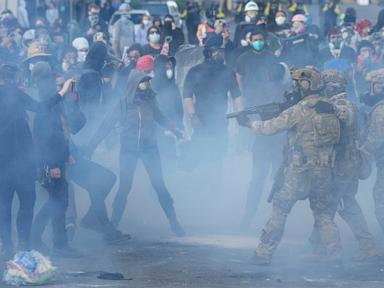
Federal prosecution of individuals involved in attacks on Immigration and Customs Enforcement (ICE) facilities operates on a distinct legal and strategic matrix. When a protester is sentenced to 30 months in federal prison for assaulting a federal officer during an anti-ICE demonstration, the outcome is not arbitrary. It is the direct result of a highly codified judicial calculus.
To understand this legal mechanic, one must dissect the intersection of ideological activism, federal statutory thresholds, and the United States Sentencing Guidelines. The sentencing of an activist to a two-and-a-half-year prison term provides a baseline case study in how the Department of Justice (DOJ) quantifies civil unrest when it crosses the threshold into felony interference with government operations.
The Statutory Architecture of Federal Officer Assault
The prosecution of protest-related violence shifts fundamentally when the target is a federal employee or facility. Under 18 U.S.C. § 111, the charge of assaulting, resisting, or impeding certain officers or employees carries specific tiers of severity that dictate the baseline of any criminal indictment.
The statute operates on a three-tiered escalation framework:
- Simple Assault: Actions involving intimidation or minor contact without bodily injury. This is classified as a misdemeanor with a maximum penalty of one year in prison.
- All Other Cases: Physical contact or an imminent threat of physical contact that involves physical force but lacks a dangerous weapon or serious bodily injury. This elevates the offense to a felony with a maximum penalty of eight years.
- Enhanced Assault: The use of a deadly or dangerous weapon, or the infliction of bodily injury. This carries a maximum statutory penalty of 20 years.
A 30-month sentence indicates that the offense conduct landed squarely within the second or third tiers, mitigated or aggravated by specific operational variables. In these scenarios, the prosecution does not need to prove the defendant knew the victim was a federal officer; the status of the victim as a federal asset establishes federal jurisdiction automatically.
The Sentencing Guidelines Calculation Matrix
Federal sentencing is governed by a mathematical formula established by the U.S. Sentencing Commission. The Base Offense Level for aggravated assault under Guidelines Section 2A2.2 begins at a score of 14. From this baseline, specific offense characteristics act as numerical multipliers.
[Base Offense Level: 14]
   + [Weapon Use: +2 to +4]
   + [Official Victim Enhancement: +3]
   + [Injury Multipliers: +2 to +7]
   - [Acceptance of Responsibility: -2 to -3]
==============================================
= Total Offense Level -> Cross-Referenced with Criminal History Category
The application of these variables explains the variance between a probationary sentence and multi-year active incarceration:
The Official Victim Enhancement
Under U.S.S.G. § 3A1.2, if the victim is a government officer or employee and the offense was motivated by their official status, the offense level increases automatically by 3 levels. This adjustment explicitly penalizes the ideological targeting of ICE or other federal personnel.
Weapon Classification Mechanics
In the context of civil unrest, a "dangerous weapon" is defined broadly. It is not limited to firearms or knives. Courts routinely classify makeshift items thrown or wielded by protesters—such as frozen water bottles, lasers, chemical irritants, bricks, or shield edges—as dangerous weapons if their deployment is capable of causing bodily harm. The introduction of such an object triggers an immediate 3-level or 4-level increase.
Injury and Intent Variables
If the assault results in bodily injury, the offense level escalates on a sliding scale from +2 (bodily injury) to +7 (permanent or life-threatening bodily injury).
Once the Total Offense Level is determined, it is plotted against the defendant’s Criminal History Category (ranging from I for first-time offenders to VI for career criminals). A 30-month sentence sits at the intersection of a mid-range Offense Level (typically between 17 and 19) and a low Criminal History Category (Category I), reflecting an offender with little to no prior criminal record who engaged in significant physical resistance or used a makeshift weapon.
Operational Friction and the Deterrence Mandate
The Department of Justice utilizes strategic prosecution to manage operational friction at federal installations. Facilities associated with ICE, the Department of Homeland Security (DHS), and the Federal Bureau of Prisons represent critical infrastructure. When protests target these specific hubs, the enforcement strategy pivots from crowd management to asset protection.
The judicial deployment of a 30-month sentence serves a dual operational purpose.
First, specific deterrence isolates the individual actor, removing them from the operational ecosystem of localized activism. Second, general deterrence aims to alter the risk-reward calculation for other decentralized actors. By securing multi-year felony convictions rather than local misdemeanor citations, federal prosecutors signal that the cost of crossing the threshold from first amendment expression to physical interference with federal property is structurally prohibitive.
This deterrence strategy faces structural limitations. In decentralized, highly ideological movements, actors frequently operate under a framework of cognitive bias regarding the likelihood of federal apprehension. The perceived ideological reward of disruptive action can decouple from the actual legal risk, rendering general deterrence less effective in highly volatile political climates than in structured corporate or financial environments.
Executive Mandates and Prosecutorial Discretion
The severity of outcomes in these cases is heavily influenced by prevailing internal guidelines from the Executive Branch. The Attorney General issues memoranda that dictate how U.S. Attorneys across various districts prioritize resources.
During periods of heightened civil unrest targeting immigration infrastructure, Main Justice frequently instructs federal prosecutors to maximize charges, oppose lenient plea agreements, and seek sentences at the top of the applicable guidelines range. This top-down pressure removes the informal diversion programs often available in state-level courts for first-time non-violent offenders, ensuring that physical altercations with ICE personnel result in institutional confinement.
The long-term asset management strategy for federal law enforcement relies on maintaining this rigid boundary. By prosecuting these cases under federal felony statutes rather than leaving them to local municipal police forces, the federal government establishes a uniform nationwide standard of zero-tolerance regarding physical resistance at its operational perimeters. This systemic uniformity limits the ability of localized protest movements to exploit variations in municipal enforcement priorities.