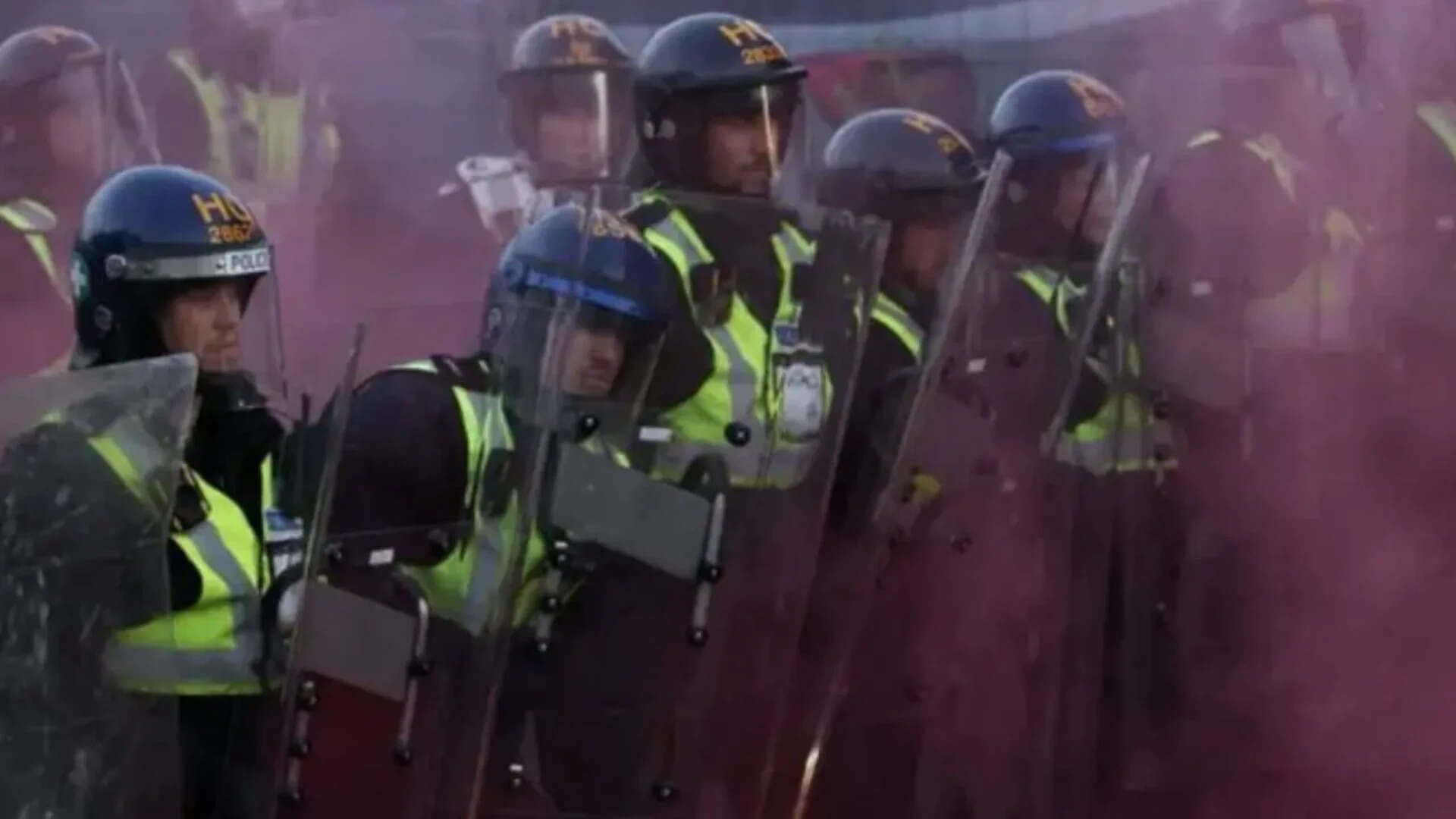
Civil unrest transitions from peaceful assembly to violent confrontation through a predictable sequence of operational bottlenecks and tactical friction points. The recent demonstration in Southampton, sparked by the murder of Henry Nowak, resulted in 11 injured police officers and two arrests. This outcome is not an isolated anomaly; it is the direct consequence of an asymmetrical engagement dynamic. When crowd numbers, emotional volatility, and police deployment strategies misalign, the friction points manifest as physical casualties and localized law enforcement containment failures.
To evaluate why a localized protest degenerated into an environment where law enforcement sustained a disproportional injury-to-arrest ratio ($11:2$), the incident must be deconstructed using crowd dynamics frameworks, tactical capacity limits, and communication asymmetry.
The Asymmetrical Friction Framework
The escalation of the Southampton protest reveals a stark imbalance in engagement mechanics. In standard crowd management theory, a successful containment strategy relies on maintaining an equilibrium between crowd velocity and law enforcement density. When this equilibrium breaks down, tactical friction occurs.
Three core variables dictate the escalation curve of a demonstration:
- Emotional Volatility Velocity: The speed at which collective grief or anger transitions into targeted physical aggression. In the context of the Henry Nowak murder, the underlying catalyst carried high systemic resonance, meaning the crowd possessed a pre-existing ideological cohesion that lowered the threshold for collective action.
- Tactical Spatial Constraints: The physical architecture of the protest zone. Narrow streets, urban choke points, and a lack of open staging areas prevent law enforcement from deploying traditional lateral containment barriers, forcing officers into direct, high-density contact with protesters.
- Force-to-Crowd Ratio: The mathematical relationship between the number of active demonstrators and the number of deployed, equipped public order officers.
The Southampton data point—11 injured officers against only two arrests—strongly indicates an operational state where law enforcement was operating at a severe capacity deficit. When officers are outnumbered or structurally restricted, their operational objective shifts from active dispersal and targeted extraction (arresting agitators) to pure survival and static defense. This shift explains the low arrest yield relative to the high casualty count among personnel.
The Mechanics of Public Order Breakdown
The transition from a peaceful march to a violent flashpoint occurs at the intersection of aggregate crowd behavior and isolated tactical decisions. Standard journalistic narratives attribute this to "tempers flaring," but the structural reality is governed by specific behavioral mechanisms.
The Agitator Extraction Bottleneck
In any volatile gathering, violent acts are typically initiated by a small minority—often less than $5%$ of the total assembly. Law enforcement strategies rely on the swift, surgical extraction of these high-risk individuals to prevent their behavior from normalizing across the broader crowd.
When the force-to-crowd ratio is inadequate, executing an extraction requires moving a small squad of officers deep into a hostile crowd perimeter. This creates an immediate tactical vulnerability. The extraction squad becomes isolated, drawing concentrated counter-responses from the crowd. If the squad cannot safely retreat with the target, the operation stalls, resulting in sustained hand-to-hand combat where officers sustain blunt-force injuries without achieving the arrest objective.
De-individuation and Spatial Density
As spatial density increases within urban corridors, individuals within a crowd experience de-individuation—a psychological state where personal accountability dissolves into collective anonymity. This effect is compounded when law enforcement boundaries are perceived as static or retreating. If a crowd observes that aggressive actions (such as throwing projectiles) do not result in immediate tactical retaliation or arrest, the perceived risk of participation drops to zero. The behavioral contagion spreads, transforming peaceful demonstrators into active participants or human shields for violent actors.
Law Enforcement Casualty Vectors
The metric of 11 injured officers underscores specific vulnerabilities in equipment deployment and tactical positioning during the Southampton deployment. Public order policing involves balancing mobility against protection.
- Blunt Force and Projectile Trauma: High officer injury rates coupled with low arrest counts occur when a crowd utilizes stand-off weapons—bricks, bottles, or improvised incendiaries—against a static police line. If officers are ordered to hold a geographic position without authorization to advance or disperse the crowd, they become passive targets.
- Equipment Compromise: Standard riot shields and personal protective equipment (PPE) are designed for forward-facing defense. In fluid urban environments, crowds can flank fixed lines, exposing officers' unprotected sides and rears to kinetic impacts.
- Respiratory and Environmental Stress: Prolonged deployments in high-stress environments induce rapid physical exhaustion. An exhausted officer experiences degraded reaction times, making them significantly more susceptible to musculoskeletal injuries during physical altercations.
The operational limitation here is clear: holding a fixed perimeter in a high-volatility environment without the manpower to execute dispersal maneuvers guarantees a compounding casualty rate for law enforcement.
Strategic Vulnerabilities in Current Crowd Protocols
The outcomes observed in Southampton expose systemic vulnerabilities that challenge standard municipal policing models. Municipalities frequently miscalculate the resource requirements for protests linked to high-profile criminal cases, treating them as standard political marches rather than highly volatile, emotionally charged events.
The primary structural flaw is a reliance on reactive deployment. Units are often held in reserve, away from the main assembly, to avoid "provoking" the crowd through a militarized appearance. While psychologically logical, this creates a time-lag bottleneck. If the emotional volatility velocity spikes unexpectedly, the transition time required to move reserve units from staging areas into active deployment lines allows the crowd to seize geographic initiatives, control key intersections, and overwhelm the thin line of initial first responders.
The second limitation is the breakdown of tactical communication. In high-density urban environments, cellular networks become congested, and radio frequencies suffer from audio degradation due to ambient noise. When field commanders lose real-time visibility into specific sectors of the protest line, localized units are forced to make independent tactical decisions without macro-level coordination, leading to uneven line density and exploitable gaps.
Tactical Correctives for Municipal Management
To prevent localized demonstrations from deteriorating into high-casualty containment failures, municipal agencies must shift from static defense frameworks to dynamic resource allocation models.
First, the deployment calculus must prioritize the immediate stabilization of the force-to-crowd ratio at the identified flashpoints. If intelligence indicators suggest high emotional volatility, public order units must be positioned in high-visibility, forward-deployed formations from the inception of the event. The deployment of protective gear must not be delayed out of a fear of optics; protective readiness is a prerequisite for crowd deterrence.
Second, tactical doctrine must prioritize spatial management over static containment. Law enforcement command structures should utilize mobile vectoring—using vehicles and modular barriers to continuously alter the crowd's path of travel, preventing the assembly from settling into a high-density, static mass in narrow urban corridors. By keeping the crowd in motion, the formation of stable, aggressive front lines is structurally disrupted, lowering the probability of coordinated assaults on police personnel.
Finally, extraction protocols must be supported by real-time overhead surveillance and dedicated arrest teams equipped for rapid insertion and extraction via mechanized assets. Removing the structural bottleneck of manual crowd penetration reduces the exposure time of officers to hostile actions, shifting the operational metrics away from high casualty rates and toward targeted accountability.