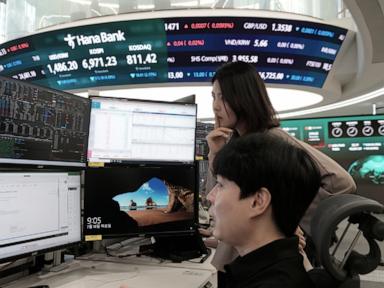
Capital markets do not react to events in isolation; they price the complex interaction of monetary policy, geopolitical friction, and structural sector positioning. The recent sharp contraction across major East Asian equity indices—most notably a 6.6% capitulation in South Korea’s Kospi index to 6,816.70—serves as a case study in how these three forces can collide to trigger severe market drawdowns.
While mainstream market commentary attributed this downturn to generalized risk-off sentiment, an analytical breakdown reveals a highly logical transmission mechanism. The sell-off was driven by a hawkish policy pivot from the Bank of Korea (BOK), escalating supply-chain risks in the Persian Gulf, and a critical valuation reassessment within the global artificial intelligence hardware stack. Recently making headlines in related news: The Biological Front Line of the American Military.
The Monetary Catalyst: The Bank of Korea’s Cost of Capital Shock
The immediate trigger for the domestic equity rout in Seoul was an unexpected interest rate hike by the Bank of Korea—the central bank’s first rate increase since 2023. Structurally, this policy decision must be viewed as a direct defensive maneuver against imported inflation.
With the military conflict between the United States and Iran escalating, global energy benchmarks have experienced upward pressure, with Brent crude trading near $84.55 per barrel—up from approximately $72 per barrel in late February. Because South Korea imports virtually all of its hydrocarbons, an elevated oil price acts as an immediate tax on both industrial margins and consumer purchasing power. By raising the benchmark repo rate, the BOK sought to defend the South Korean Won and anchor domestic inflation expectations, but it did so at the expense of equity valuations. Further insights on this are covered by NBC News.
The mechanism through which this interest rate hike impacted the Kospi can be mapped across three distinct corporate finance transmission channels:
- Discount Rate Expansion: In equity valuation models, the cost of equity is heavily dependent on the risk-free rate ($R_f$). A sudden increase in the risk-free rate expands the weighted average cost of capital (WACC) for domestic firms, directly compressing the present value of future cash flows.
- Highly Leveraged Balances: South Korean corporate structures, particularly the secondary tier of suppliers within the chaebol ecosystems, carry substantial short-term debt. The sudden increase in debt-servicing costs immediately threatens net income margins.
- Currency Dynamics: While higher rates typically support a domestic currency, they can also trigger defensive capital reallocation out of risk assets and into local fixed-income instruments, creating localized liquidity drain from equities.
The Semiconductor Volatility Transmission Chain
The Kospi's 6.6% drop was disproportionately driven by its heavy concentration in the global semiconductor supply chain. Equity drawdowns were concentrated in systemic memory chip manufacturers, with SK Hynix plunging 11.2% and Samsung Electronics shedding 8.2%.
This was not a localized panic; it was a regional re-rating of hardware valuations that extended directly into Japan and Taiwan. In Tokyo, the Nikkei 225 fell 2.9% to 66,767.64, led by a 13.5% collapse in memory producer Kioxia, alongside significant pullbacks in critical upstream equipment providers like Tokyo Electron (-5.2%) and Advantest (-5.6%).
This synchronized sell-off exposes the high beta of the semiconductor sector to macroeconomic shocks. The structural vulnerability of these companies is governed by two key dynamics:
The Artificial Intelligence Capex Debate
Over the past two years, global technology valuations have been sustained by massive capital expenditure (Capex) allocations toward artificial intelligence infrastructure. However, high-bandwidth memory (HBM) manufacturers like SK Hynix and Samsung operate on highly cyclical capital cycles. When global monetary conditions tighten, institutional investors begin to demand proof of monetization from software buyers down the value chain. If the software layer cannot generate high-margin revenue to justify the massive hardware expenditures, the hardware suppliers face a severe demand cliff.
Inventory Cycle Sensitivity
Semiconductors are highly sensitive to the global purchasing managers' index (PMI) and manufacturing cycles. When geopolitical tensions threaten global shipping lanes, logistics costs escalate, and lead times lengthen. This forces hardware companies to carry larger, more expensive inventories (shifting from "Just-in-Time" to "Just-in-Case" manufacturing), which lowers capital efficiency and return on invested capital (ROIC).
Geopolitical Friction and the Crude Oil Risk Premium
The geopolitical backdrop is defined by active military exchanges between the U.S. and Iran, which have disrupted maritime transit through the Strait of Hormuz—a bottleneck through which approximately 20% of global petroleum liquids flow.
While Brent crude slipped 0.4% on the day to $84.55 a barrel due to short-term algorithmic trading, the structural risk premium remains heavily priced into the forward curve.
The economic relationship between Persian Gulf shipping disruptions and East Asian equity performance can be quantified through an energy transmission model:
[Persian Gulf Strikes] ➔ [Strait of Hormuz Congestion] ➔ [Higher Maritime Freight & Insurance Rates]
                                                                  │
                                                                  ▼
[Macro Policy Shock (BOK Rate Hike)] ◀─── [Imported Cost Inflation] ◀─── [Elevated Crude Oil Prices]
            │
            ▼
[Equity Valuation Compression]
This structural loop explains why regional outliers exist. For example, Hong Kong’s Hang Seng Index diverged from the regional trend, gaining 1.7% to 25,111.22. This divergence was driven by localized regulatory developments rather than energy flows. The Cyberspace Administration of China approved Apple's proprietary AI tool for domestic use, with Alibaba's Qwen model slated for integration. Consequently, Alibaba's shares rose 4.4%, demonstrating that highly specific, idiosyncratic regulatory clearances can temporarily decouple individual equities from broader macroeconomic headwinds.
Strategic Allocation Framework in High-Volatility Regimes
For institutional allocators navigating this market regime, standard passive index exposure across East Asian equities presents unacceptable drawdowns. Managing risk in this environment requires a structured reallocation strategy.
- Reduce Exposure to High-Beta Capital-Intensive Sectors: Shift allocation away from semiconductor manufacturers that are highly sensitive to both hardware capex cycles and localized interest rate shocks.
- Identify Regulatory and Platform Decoupling Opportunities: Seek exposure in markets where local regulatory catalysts (such as AI model approvals in mainland China and Hong Kong) provide fundamental support independent of global macroeconomic conditions.
- Hedge via Energy and Freight Derivatives: Because East Asian corporate margins are highly sensitive to energy transport costs, portfolios heavily weighted in Asian manufacturing must hold structural long positions in Brent crude or global maritime freight futures to offset downside equity risk.