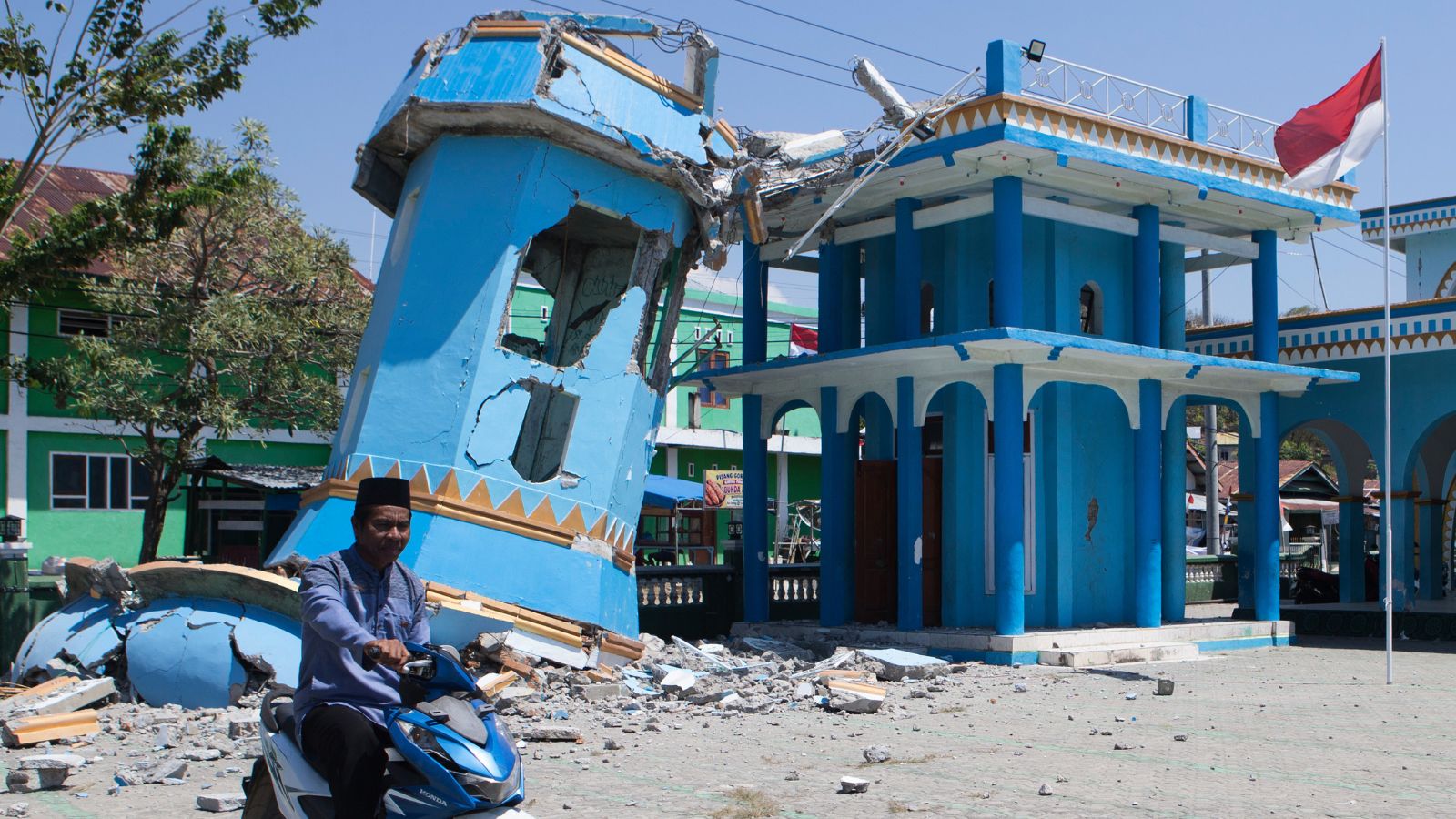
When a seismic event coincides with a national commemoration, the friction points between state capability, logistical capacity, and public visibility become starkly apparent. The earthquake that struck Indonesia and killed 54 individuals while simultaneously eclipsing Independence Day celebrations is not merely a tragedy of geology; it is a stress test of institutional response functions. Crisis management in developing archipelago nations requires navigating severe geographic fragmentation, structural infrastructure deficits, and the administrative drag of concurrent public events.
Understanding why aid delivery stalls under these conditions demands a structural breakdown of how disaster response systems fail when multiple variables compete for state attention and physical resources.
The Dual Shock Framework
Every major disaster occurring during a fixed national event creates a dual shock scenario. The state must manage two opposing operational vectors simultaneously: the centrifugal pull of decentralized emergency response and the centripetal pull of centralized national ceremonies.
Independence Day demands high visibility, symbolic unity, and the allocation of security and logistical assets toward public displays of statehood. Conversely, an earthquake demands the rapid dispersal of heavy machinery, medical teams, and supply chains into isolated regional pockets.
When these vectors intersect, resource contention occurs at the administrative apex. Regional disaster management agencies often find their requisition requests bottlenecked by bureaucratic protocols that prioritize national continuity over localized triage. The opportunity cost of deploying military transport helicopters to ceremonial flyovers rather than rubble extraction represents a quantifiable failure in resource allocation efficiency.
Geographic Friction and the Archipelago Logistical Penalty
Indonesia presents a distinct logistical constraint profile characterized by thousands of inhabited islands separated by deep marine trenches and limited inter-island transport corridors. The physics of disaster relief in this environment are governed by the tyranny of distance and point-to-point transfer costs.
When an earthquake strikes a seismically active fault line near vulnerable population centers, the primary transport arteries—ports, bridges, and regional airstrips—suffer immediate structural degradation. The logistics chain breaks down into three distinct friction points:
- The First-Mile Disruption: Road networks fractured by landslides or liquefaction prevent heavy trucks from moving supplies out of provincial hubs.
- The Inter-Island Transfer Gap: Limited availability of landing craft utility vessels restricts the heavy armor and civil engineering equipment needed to clear debris from secondary ports.
- The Last-Mile Distribution Failure: Mountainous terrain and damaged local bridges force relief workers to rely on foot transport or limited aerial drop capabilities, which drastically reduces tonnage delivery per hour.
Without a pre-positioned network of modular warehousing and decentralized maritime staging zones, response times degrade exponentially with distance from the national capital.
The Temporal Decay Curve of Search and Rescue
The effectiveness of any post-earthquake operation decays rapidly according to a well-established physiological curve. Survival rates for trapped individuals drop precipitously after the seventy-two-hour window closes.
During the Indonesian earthquake response, the overlap with national holiday schedules introduced administrative latency. Government offices operated with skeleton crews, procurement approvals lagged, and customs clearance for international humanitarian aid experienced processing backlogs. This temporal delay transforms survivable entrapment scenarios into fatal outcomes.
The structural rigidity of public sector hierarchies prevents mid-level bureaucrats from making autonomous expenditure decisions without sign-off from leadership preoccupied with holiday schedules. This administrative inertia represents a hidden tax on human life during systemic shocks.
Economic and Psychological Displacement Costs
The financial impact of a disaster extending across national holidays ripples through both macro and micro economic indicators. Tourism revenues, regional trade, and small-scale commerce halt abruptly. Displaced populations living in temporary tarpaulin camps face immediate public health hazards, including waterborne diseases and acute psychological trauma.
The psychological impact of experiencing a fatal natural disaster on a day designated for national celebration creates a distinct civic alienation. Citizens trapped in damaged infrastructure while national broadcasts project images of parades and speeches experience a profound disconnect from state support mechanisms. This loss of civic trust complicates post-disaster recovery, as communities become cynical regarding state promises of reconstruction funds and housing subsidies.
Resource Allocation Matrices for Multi-Variable Crises
To resolve the friction points exposed by concurrent crises, disaster management organizations must transition from reactive deployment models to predictive algorithmic dispatching. This requires shifting capital expenditure toward decentralized prepositioning.
The primary operational countermeasure involves establishing independent regional logistics hubs capable of operating autonomously for fourteen days without central government authorization. These hubs must maintain dedicated fleets of rotary-wing aircraft and shallow-draft vessels immune to the administrative freezes that accompany national holidays or political transitions.
Furthermore, procurement protocols must incorporate automated trigger mechanisms. Once a seismic magnitude threshold is breached within a specific population density index, statutory spending caps and bureaucratic sign-off requirements must automatically suspend. This legislative pre-authorization removes the human bottleneck in the chain of command, allowing field commanders to deploy capital and assets directly to the point of impact without waiting for ministerial clearance.
Resource prioritization protocols must also establish a strict hierarchy where emergency life-safety operations supersede all state ceremonial functions by default law. By codifying this operational subordination, nations can eliminate the structural conflict between national pageantry and humanitarian necessity, ensuring that state capacity is channeled entirely toward systemic preservation when disaster strikes.