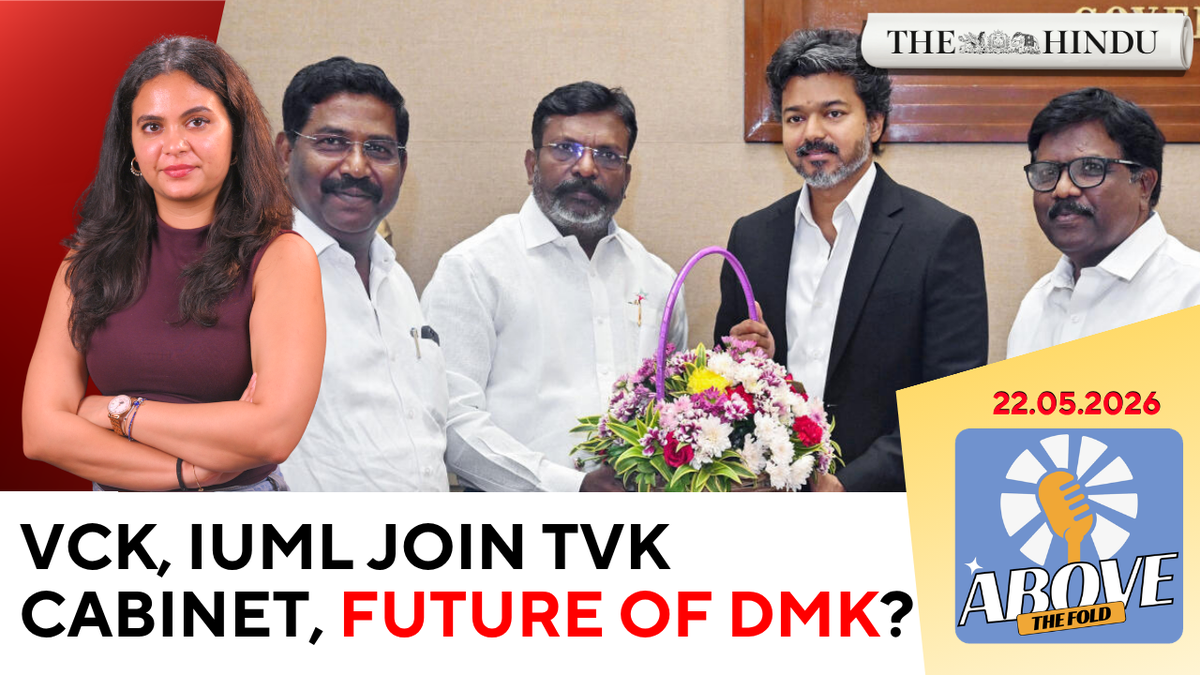
The completion of the May 2026 cabinet expansion by Chief Minister C. Joseph Vijay’s Tamilaga Vettri Kazhagam (TVK) marks a structural reconfiguration of Tamil Nadu’s political architecture. By expanding the Council of Ministers to its maximum sanctioned capacity of 35, the newly formed TVK government did not merely secure its parliamentary majority in a hung assembly; it systematically dismantled the asset base of the Dravida Munnetra Kazhagam (DMK).
This expansion represents a calculated exercise in coalition engineering. The induction of legislators from the Indian National Congress, the Viduthalai Chiruthaigal Katchi (VCK), and the Indian Union Muslim League (IUML) into a formal power-sharing structure structuralizes the isolation of the DMK. This transition from external alignment to formal cabinet participation breaks a 59-year regional tradition of single-party dominance, moving the state into an era of multi-party executive governance.
The Strategic Realignment of Alliance Capital
The primary mechanism driving the DMK’s current vulnerability is the institutional migration of its traditional Secular Progressive Alliance (SPA) partners. The TVK’s cabinet allocation strategy addresses the structural friction that historically existed between the DMK and its junior partners regarding power sharing.
The Inclusion Function of Minor Parties
For nearly six decades, Tamil Nadu’s major Dravidian parties maintained a strict monopoly over executive governance, delegating alliance partners to legislative seat allocation without executive representation. The TVK broke this model by utilizing cabinet berths as a transactional mechanism to clear the majority threshold of 118 seats in the 234-member house.
- The Congress Re-Entry: The induction of two Congress MLAs—S. Rajesh Kumar and P. Viswanathan—ends a 59-year exclusion of the national party from the state executive dating back to 1967. By granting formal portfolios to Congress, the TVK secured its flank against national intervention while stripping the DMK of its most stable vote-multiplying partner.
- The VCK and IUML Onboarding: The subsequent inclusion of VCK’s Vanni Arasu and an IUML representative directly targets the DMK's core identity. These parties represent critical socio-political blocs—specifically Dalit and minority demographics—that previously anchored the DMK's welfare coalition.
This structural shift alters the bargaining power within the state's legislative ecosystem. The DMK can no longer dictate terms to these parties from a position of asymmetric leverage; instead, those partners now possess independent institutional footholds within the current state executive.
Structural Atrophy of the DMK Voting Coalition
The DMK's single-term ouster, capped by the defeat of former Chief Minister M.K. Stalin in his long-held Kolathur constituency, reveals an underlying deterioration of its structural vote bank. The party was reduced to 59 seats. The TVK's expansion capitalizes on this displacement by addressing two vital failure points in the DMK’s operational model.
Demography and Generational Displaced Capital
The TVK’s cabinet profiles reveal a deliberate focus on demographic renewal. Out of the 35 ministers, 22 are under the age of 50, including 28-year-old Animal Husbandry Minister S. Kamali. This demographic distribution targets the younger electorate that voted against the incumbent administration.
The DMK failed to convert its governance delivery into electoral support because its campaign mechanics relied on historical legacy narratives rather than active digital mobilization and fresh faces. The TVK captured this unaligned voter capital—specifically urban, youth, and first-time voters—independent of historical caste or religious loyalties.
[TVK Executive Strategy] ──> Demographically Younger Cabinet (22 of 35 under 50)
                                 │
                                 └──> Absorbs Displaced Youth/Urban Voters
                                 │
                                 └──> Targets Structural Gaps in Old DMK Base
The Cost of Public Criticism
The tension caused by this alignment is evident in the open friction between second-line DMK cadre and their former allies. The public criticism directed at the VCK by DMK loyalists following Vanni Arasu's induction highlights an internal organizational crisis.
While top leadership attempts to limit public disputes, the lower-level party machinery is reacting to a permanent loss of local patronage networks. When a junior ally joins the executive under a rival banner, local administrative influence shifts away from the former ruling party's district secretaries.
Limitations and Operational Risks of the TVK Coalition
While the cabinet expansion successfully builds a legislative majority, the structural design of the TVK-led executive contains distinct vulnerabilities. No single-party model has been replaced without introducing new operational friction.
The Multi-Party Coordination Tax
Managing the state’s first true coalition cabinet introduces an executive coordination challenge. Chief Minister Vijay retains the critical portfolios—including Home, Public, General Administration, and Police—which consolidates core coercive and administrative authority within the TVK core.
However, delegating ministries like Agriculture, Forests, and Dairy Development to a mix of young first-time legislators and external alliance partners introduces policy execution risks.
- Portfolio Fragmentation: Distributing economic and welfare portfolios across disparate ideological entities (such as the Left parties, VCK, and Congress) increases the transaction costs of passing structural reforms.
- The Breakaway Faction Bottleneck: The TVK's reliance on support from a breakaway faction of AIADMK MLAs remains highly unstable. Major coalition partners like the CPM have openly stated they will review their support if these rebel elements receive formal ministerial positions. This dynamic limits the Chief Minister's ability to balance future cabinet reshuffles without risking a floor test.
The Strategic Reorientation
The DMK cannot recover its dominant position by simply waiting for standard anti-incumbency to wear down the TVK government. The current administration's strategy relies on systemic integration rather than a temporary legislative alliance.
To adapt to this new environment, the DMK must execute a structural overhaul across its organizational and electoral operations.
Rebuild the Local Leadership Pipeline
The party needs to systematically replace underperforming district secretaries who failed to counter the TVK’s local mobilization. Executive authority must be decentralized to younger, digitally native organizers who can challenge the TVK's appeal among first-time voters. Legacy affiliation is no longer a viable substitute for active local engagement.
Decouple Ideological Branding from Bureaucratic Deliverables
The 2026 election results demonstrate that administrative performance narratives do not automatically translate into votes when decoupled from emotional and generational alignment. Future campaigns must frame welfare initiatives through structural economic utility rather than historical appeals, directly confronting the TVK's post-ideological platform.
Implement Asymmetric Legislative Opposition
Rather than pursuing a broad attack on the entire coalition, the DMK must target policy friction points between the TVK core and its ideologically rigid partners like the Left and the VCK. Forcing legislative votes on controversial economic or land-use policies will test the stability of the cabinet, exploiting the natural policy divisions inherent to a multi-party executive.