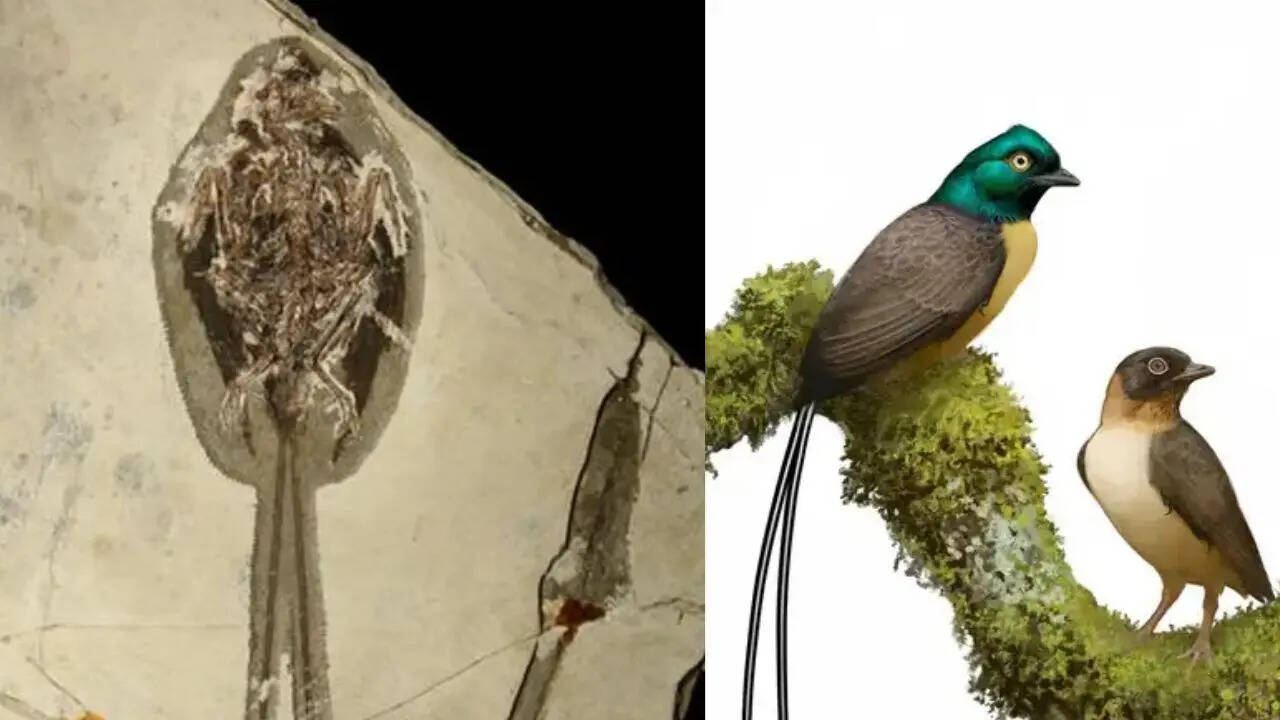
The discovery of Yuanchuanavis kompsos, a 121-million-year-old enantiornithine bird fossil from the Jehol Biota in China, challenges standard aerodynamic models of early avian evolution. The specimen possesses a pair of pintail tail feathers measuring 30 centimeters—exactly twice the length of its 15-centimeter body. In modern avian biology, structural investments of this magnitude create a profound evolutionary paradox: the aerodynamic drag penalty must be offset by an equal or greater reproductive or survival benefit. Analyzing Yuanchuanavis kompsos requires decoupling the physical constraints of early flight from the signaling mechanisms of sexual selection, establishing a quantifiable framework for how ornament morphology evolved independently of structural flight efficiency.
The Tri-Factor Morphological Framework
To understand the biological investment of Yuanchuanavis kompsos, its anatomy must be divided into three distinct operational vectors: the lifting body, the locomotor apparatus, and the aerodynamic ornament.
                                  [Total Morphological Investment]
                                                 |
         +---------------------------------------+---------------------------------------+
         |                                       |                                       |
[Lifting Body (15 cm)]                [Locomotor Apparatus]                   [Aerodynamic Ornament (30 cm)]
 - Skeletal mass distribution          - Powered flight musculature            - Dual rachis-dominated pintails
 - Aerodynamic cross-section           - Enantiornithine shoulder girdle       - High surface area-to-mass ratio
The lifting body consists of a relatively compact 15-centimeter skeletal frame. Unlike modern birds (Neornithes), enantiornithines retained a fundamentally different shoulder girdle architecture and a modified pygostyle—the fused tail vertebrae that anchor tail feathers.
The locomotor apparatus relied on a robust pectoral girdle capable of powered flight, though less biomechanically optimized than modern equivalents.
The aerodynamic ornament is comprised of the dual 30-centimeter pintail feathers. These feathers are rachis-dominated, meaning they possess a strong, central shaft with reduced or absent barbs along the proximal section, ending in an expanded distal vane. This specific architecture minimizes the mass of the feather while maximizing its visual cross-section at the terminus.
The Aerodynamic Cost Function
Every structural appendage on a flying organism alters its lift-to-drag ratio. For Yuanchuanavis kompsos, the 30-centimeter tail introduces an immediate structural bottleneck to flight efficiency. The total drag ($D_{\text{total}}$) experienced by the organism during flight is defined by the summation of three distinct forces:
$$D_{\text{total}} = D_{\text{parasite}} + D_{\text{induced}} + D_{\text{ornament}}$$
$D_{\text{parasite}}$ represents the profile and skin friction drag of the 15-centimeter body. $D_{\text{induced}}$ is the penalty incurred by the generation of lift via the wings. $D_{\text{ornament}}$ is the independent drag profile generated specifically by the long pintail feathers.
The pintail structure impacts the system through two primary mechanisms:
- Skin Friction Drag: The sheer surface area of a 30-centimeter feather pair, even when streamlined, interacts continuously with the boundary layer of air moving over the bird's body.
- Parasitic Vortex Generation: As the bird moves forward, the distal vanes at the tips of the long feathers create localized turbulence. These vortices disrupt the clean wake behind the organism, increasing base drag.
Because the tail feathers are twice the length of the body, $D_{\text{ornament}}$ scales non-linearly with velocity. At high speeds, the power required to overcome this ornament-induced drag increases cubically ($P \propto v^3$). This mathematical reality means Yuanchuanavis kompsos was structurally barred from high-velocity pursuit or efficient long-distance foraging. Its flight envelope was limited to low-speed, high-maneuverability environments, such as the dense, forested ecosystems of the Early Cretaceous.
Honest Signaling and Honest Costs
The persistence of a trait that actively degrades flight performance can only be explained through the lens of sexual selection and Zahavi’s handicap principle. In evolutionary biology, an "honest signal" is a trait that cannot be faked because its production and maintenance require significant resources or carry high survival risks.
+-------------------------------------------------------------------------+
|                    The Honest Signaling Feedback Loop                   |
+-------------------------------------------------------------------------+
|                                                                         |
|  [30 cm Tail Feathers] ---> High Parasitic Drag ---> Increased Metabolic |
|          ^                                                Demand        |
|          |                                                   |          |
|          |                                                   v          |
|  Genetic Superiority  <--- Successful Foraging  <--- High Muscle Mass &   |
|   Demonstrated             Despite Handicap          Efficient Metabolism   |
|                                                                         |
+-------------------------------------------------------------------------+
The 30-centimeter tail of Yuanchuanavis kompsos served as a definitive metric of genetic fitness. A shorter tail would reduce drag, save metabolic energy, and lower predation risk. Therefore, an individual capable of surviving, foraging, and escaping predators while carrying a tail twice its body length demonstrated superior underlying physical attributes—such as higher muscle mass, a more efficient metabolism, or better predator-eviction strategies.
The structural composition of the tail further supports this hypothesis. The proximal portion of the feather is restricted to a bare rachis. By eliminating the blade-like barbs close to the body, the organism minimized the surface area directly exposed to the wing-wash, reducing the potential drag penalty. The visual impact, however, was preserved by maintaining the wide, colorful vanes at the very tip. This represents a highly optimized compromise: maximizing the visual signal-to-noise ratio while capping the absolute aerodynamic penalty.
Evolutionary Divergence: Enantiornithines vs. Modern Birds
The discovery of Yuanchuanavis kompsos highlights a major divergence in how early birds solved the problem of tail anatomy. The Jehol Biota preserves two distinct avian lineages that coexisted: the Enantiornithines ("opposite birds") and the Ornithuromorpha (the lineage leading to modern birds).
Modern birds utilize a complex, fan-shaped tail supported by a short pygostyle and a suite of specialized rectricial muscles. This arrangement allows the tail to function as a dynamic aerodynamic surface. A modern bird can spread its tail feathers to generate lift during low-speed flight, close them to reduce drag during high-speed transit, or tilt them to act as an airbrake or rudder. The tail is fully integrated into the flight control system.
In contrast, Yuanchuanavis kompsos and its enantiornithine peers lacked this dynamic control system. Their pygostyles were long and blade-like, incapable of supporting a fanned arrangement of feathers. The tail feathers were fixed insertional structures. They could not be adjusted Mid-flight to optimize lift or stability.
Consequently, the enantiornithine tail functioned almost entirely as a display organ rather than an aerodynamic tool. While ornithuromorphs were optimizing the tail for multi-role utility (combining lift generation with sexual display), enantiornithines took a path of pure decorative specialization, relying entirely on their wings for flight metrics.
Analytical Limitations and Fossil Record Taphonomy
Any analytical breakdown of fossil material must explicitly state the boundaries of its data. Taphonomy—the process of fossilization—introduces specific biases that prevent definitive conclusions on certain aerodynamic variables.
First, the fossil is a two-dimensional compression. The absolute mass of the living feathers cannot be weighed; it can only be estimated based on scaling laws derived from modern feather density. If the rachis of Yuanchuanavis kompsos was hollow and exceptionally lightweight, the mass penalty would be minimal, shifting the entire cost function strictly toward aerodynamic drag rather than inertial weight.
Second, the structural rigidity of the feather remains a hypothesis. If the 30-centimeter rachis was highly flexible, the feathers would have trailed passively behind the body during forward flight, aligning with the streamtubes of airflow and minimizing the cross-sectional area exposed to the wind. If the rachis was stiff, the feathers would have resisted deformation, maintaining their shape and significantly increasing both drag and pitching moments during turns.
Strategic Reclassification of Early Avian Niches
The quantification of the Yuanchuanavis kompsos morphotype forces a reclassification of how early avian ecosystems were structured. The traditional view of early birds as uniform, primitive flyers is obsolete. Instead, the data points to a highly stratified ecological matrix based on structural investment:
- Aerodynamic Maximizers (Ornithuromorphs): Characterized by short, functional fan tails, high lift-to-drag ratios, and low structural ornament penalties. Optimized for open-air transit, high-speed flight, and efficient foraging.
- Signal Maximizers (Enantiornithines like Yuanchuanavis): Characterized by extreme, non-aerodynamic structural ornaments, high parasitic drag profiles, and fixed tail geometry. Optimized for short-burst flight within dense cover, where localized sexual signaling outperformed the need for sustained aerodynamic efficiency.
This ecological bifurcation demonstrates that the selective pressures driving early bird evolution were not monolithic. The development of the avian body plan was driven by a constant tension between mechanical optimization and the reproductive demands of sexual selection. The enantiornithine lineage proved that flight did not need to be perfect to be evolutionary viable; it merely needed to be functional enough to support the heavy baggage of survival.