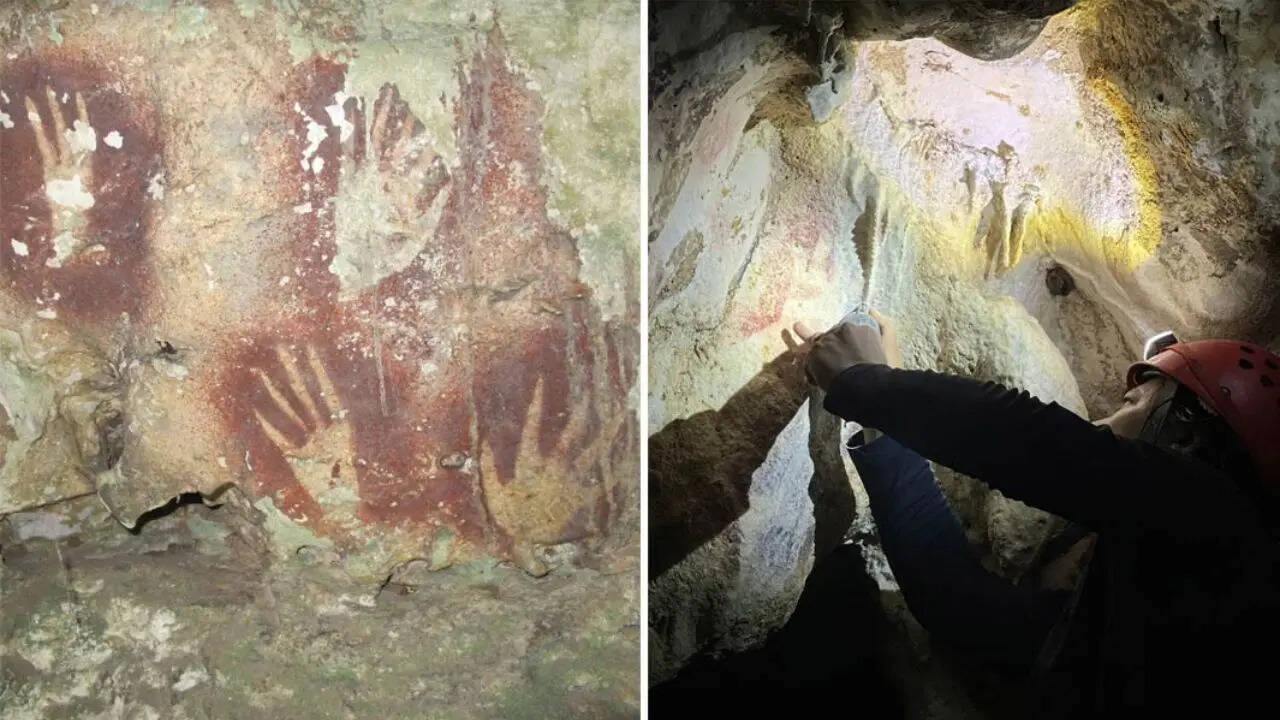
The mainstream media is currently tripping over itself to celebrate a new Guinness World Record. The cause for celebration? A depiction of a pig and three human-like figures inside the Leang Karampuang cave in Sulawesi, Indonesia, recently dated to at least 67,800 years ago.
The standard commentary follows a predictable, lazy script. Pundits claim this rock art "rewrites human history," proves a sudden "cognitive leap," and marks the definitive dawn of complex storytelling.
It does none of those things.
This obsessive hyper-fixation on pinning a trophy to the "oldest" piece of pigment on stone betrays a massive flaw in modern archaeology. We are treating human evolution like a tech product launch, searching for a single "Version 1.0" kickoff date for human intelligence. By treating art as a proxy for cognitive capacity, the scientific consensus misses a much deeper, more uncomfortable truth: our ancestors did not suddenly wake up and become smart 68,000 years ago. They were already smart. We are just exceptionally bad at finding their receipts.
The Flawed Chemistry of the Record Breaking Cave
To understand why this record-breaking claim is built on shaky foundations, you have to look at how scientists arrived at the 67,800-year figure. The research team, including scientists from Griffith University and the Indonesian National Research and Innovation Agency (BRIN), used a method called laser-ablation U-series imaging.
Traditional radiocarbon dating is useless here; charcoal fades, and organic binders degrade. Instead, scientists date the tiny layers of calcium carbonate—the "cave popcorn"—that form over the pigment. They measure the radioactive decay of uranium into thorium within these mineral crusts.
Here is the technical reality the hype cycle ignores:
- Uranium Mobility: Uranium is water-soluble; thorium is not. If groundwater leaches uranium out of the calcite layer over millennia, the ratio shifts. The sample artificially looks significantly older than it actually is.
- Open-System Dilemma: Geochemists know that cave crusts rarely act as a perfectly sealed system. While laser ablation offers higher spatial resolution than older bulk-sampling methods, it does not magically fix the geochemical instability of porous limestone in a tropical, high-humidity environment like Sulawesi.
- The Minimum Age Trap: This method only dates the crust on top of the paint. It establishes a minimum age, not an absolute date of creation. The art could be older, or the crust could be contaminated.
Treating a highly volatile geochemical dating method as an absolute, record-shattering metric suitable for a Guinness plaque is sensationalism masking as definitive science.
The Soft Medium Fallacy: Why Stone Bias Blinds Us
Let’s run a thought experiment. Imagine a devastating global cataclysm strikes tomorrow, wiping out electricity, digital storage, and paper. Ten thousand years from now, future archaeologists excavate the remnants of our civilization. They find millions of plastic lawn ornaments and stone carvings of corporate logos, but every single masterpiece by Rembrandt, Da Vinci, and digital artist collectives has rotted away. If those future researchers concluded that 21st-century humans were intellectually capped at designing plastic flamingos, they would be committing the exact same error modern anthropology makes every single day.
Archaeologists suffer from severe "stone bias." We assume that because stone survives, stone was the primary medium.
Our ancestors lived in rich, biodiverse tropical environments. They had access to wood, bamboo, animal hides, vines, feathers, and bark. They almost certainly carved intricate totems, painted massive murals on textiles, and engineered complex structural art long before anyone picked up a chunk of ochre and walked into Leang Karampuang.
Wood rots in a damp jungle within decades. Bone dissolves in acidic soil within centuries. Pigment on an exposed cliff face washes away in a few rainy seasons. The only reason the Sulawesi art survived is because it was tucked inside a deep limestone alcove where mineral-rich water happened to seal it in stone armor.
The 67,800-year-old art does not represent the dawn of storytelling. It represents a lottery winner. It is the microscopic fraction of a percent of ancient human expression that happened to be deposited in the precise geochemical environment required to survive deep time.
To argue that human narrative ability leaped forward at this specific date is equivalent to arguing that music did not exist before the invention of the phonograph record.
Dismantling the Cognitive Leap Myth
The mainstream narrative insists on a linear timeline of human capability that looks something like this:
| Era | Assumed Cognitive State | Evidence |
|---|---|---|
| 200,000 Years Ago | Anatomically Modern, Culturally Stagnant | Basic stone tools, no art |
| 70,000 Years Ago | The "Cognitive Revolution" | Appearance of cave art, beads |
| 10,000 Years Ago | Civilization | Agriculture, permanent settlements |
This table is a lie. It is an outdated, Eurocentric model that originally tried to place the "spark of genius" in Western Europe 40,000 years ago (think Altamira and Lascaux). When older art was found in Africa and Indonesia, the timeline was simply stretched backward, but the flawed logic remained intact: No art equals no complex mind.
This premise is completely broken. Anatomically modern humans (Homo sapiens) evolved roughly 300,000 years ago. Their cranial capacity, genetic makeup, and neurological architecture were virtually identical to yours.
To suggest that humans walked the earth for over 200,000 years as mindless automatons—unable to conceptualize stories or abstract thoughts until they suddenly started drawing pigs in Indonesia—defies evolutionary biology. Complex language and abstract thought require massive, metabolically expensive brains. Natural selection would never have preserved and expanded the energy-hungry human brain for hundreds of thousands of years if our ancestors were not actively using its full cognitive capacity to survive, navigate, hunt, and build complex social structures.
The lack of surviving art before 70,000 years ago is an preservation issue, not an intelligence issue.
The Dark Side of Archaeology's Record Obsession
I have watched research institutions and media outlets turn scientific discovery into a toxic hype machine. When funding, prestige, and institutional survival rely on clickbait headlines and record books, the science suffers.
The rush to claim the "oldest" tag creates a dangerous confirmation bias. Teams are incentivized to hunt for the oldest possible dates within a sample's margin of error while downplaying the anomalies, open-system contamination risks, and alternative interpretations.
Furthermore, this obsession devalues the actual anthropological context of the site. The Leang Karampuang painting is remarkable because of its narrative composition—the interaction between figures—not because of an arbitrary number verified by a beer marketing company's record book. By turning deep history into an Olympic sprint, we obscure the real patterns of human migration, cultural exchange, and adaptation across Wallacea.
Stop Asking When We Became Smart
The public constantly types variations of the same question into search engines: When did humans develop abstract thought? or What is the oldest evidence of human intelligence?
These are completely the wrong questions. They assume intelligence is a switch that clicked on.
If you want a true understanding of ancient human capacity, look at the logistics required to get to Sulawesi in the first place. Long before anyone painted that pig, ancient humans had to cross the Wallace Line—a deep-water marine barrier that never closed, even during the lowest sea levels of the ice ages.
To reach Sulawesi, Timor, and eventually Australia, these populations had to construct seaworthy watercraft. They had to navigate open ocean currents. They had to organize multi-generational migration strategies, manage clean water supplies at sea, and maintain linguistic cohesion across scattered islands.
Ocean seafaring requires advanced spatial reasoning, complex planning, predictive tracking of weather patterns, and sophisticated communication. That is a far more rigorous testament to the human mind than a pigment sketch on a wall. Yet, because wooden rafts do not survive 70,000 years under water, we ignore the engineering feat and obsess over the cave painting instead.
Stop looking at the walls of Leang Karampuang as the starting line of human intellect. The art on those rocks isn't the beginning of the story; it's a late-stage footnote written by a species that had already mastered the seas, colonized the globe, and spent hundreds of millennia speaking, thinking, and creating in ways the earth simply chose not to preserve.