The night air in the high desert does not care about billionaires. It is cold, sharp, and indifferent to the metallic towers rising from the Texas brush or the Florida coast. For years, the narrative of the modern space age has been written in fire and bravado, broadcast in high-definition livestreams to millions of people watching two men throw their fortunes at the heavens. We have been taught to look at the rockets. We marvel at the steel hulls gleaming under stadium lights and the thunderous roars that shake the earth during launch.
But the real chess match never happens on the launchpad. It happens in quiet, carpeted rooms in Washington, D.C., where bureaucrats sift through mountains of paperwork, weighing the futures of companies against the tight constraints of federal budgets.
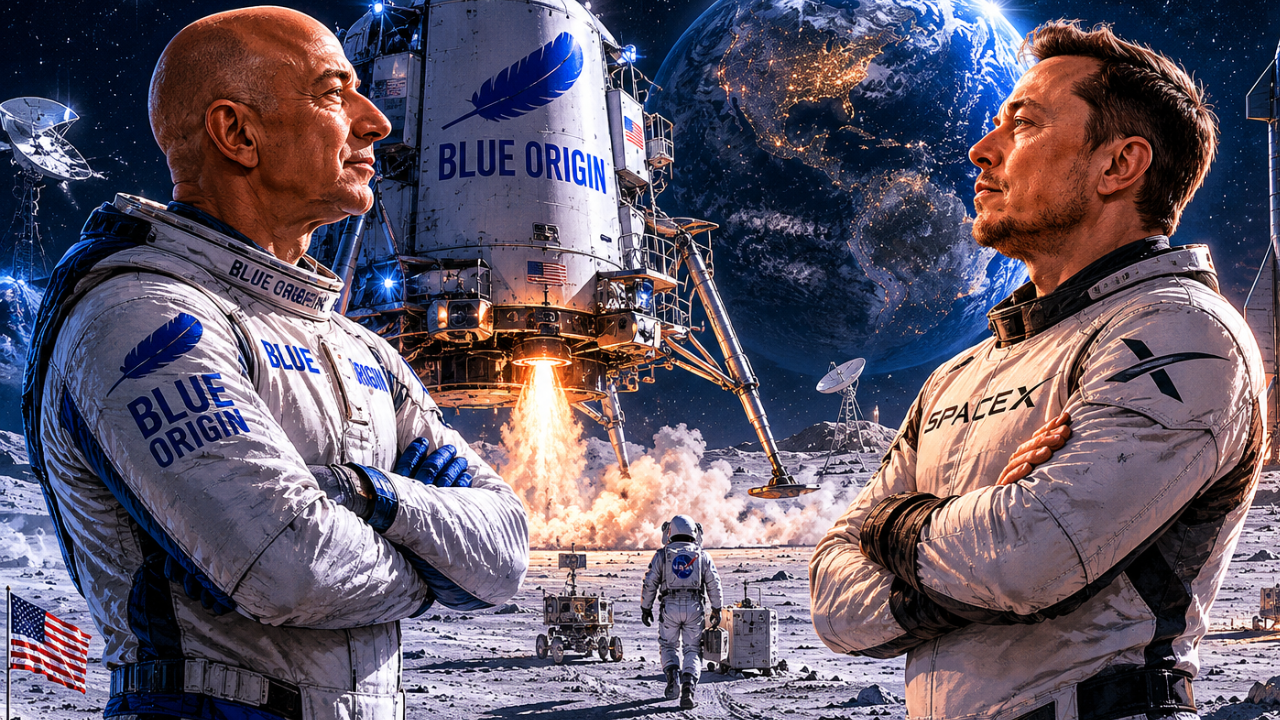
Recently, a single pen stroke shifted the gravity of the commercial space race. NASA quietly awarded a $230 million contract to Blue Origin, the aerospace venture funded by Jeff Bezos, tasking them with the first of three uncrewed lunar missions. The assignment is a massive cargo delivery to the Moon, utilizing the company’s massive Blue Moon Mark 2 lander.
To the casual observer, it looks like a standard government transaction. A line item in an agency budget. A victory for one logo over another.
Look closer. This was a heist executed in broad daylight, a strategic maneuver that snatched a prime piece of lunar real estate right out from under Elon Musk’s SpaceX. For a long time, SpaceX seemed to hold an unbreakable monopoly on NASA’s Artemis program, the ambitious initiative to return humans—and heavy gear—to the lunar surface. Now, the monopoly is fractured. The celestial gold rush has a new frontrunner, and the implications stretch far beyond the net worth of two tech titans.
The Weight of the Cargo
To understand why this specific $230 million matters, you have to understand the sheer physical hostility of space travel.
Imagine trying to move a grand piano across a frozen lake using only a remote-controlled drone. Now, replace the piano with an automated habitat module, a scientific laboratory, or a massive rover, and replace the lake with a quarter-million miles of vacuum. Every ounce of weight requires a calculable, punishing amount of fuel to escape Earth's gravity, and an equally precise amount of counter-thrust to avoid vaporizing upon impact with the Moon.
For years, NASA put its faith almost entirely in SpaceX’s Starship. The vision was grand: a towering, reusable monolith capable of ferrying massive payloads. But reliance on a single architecture is a terrifying gamble in aerospace. If one valve fails during a critical test, an entire national space program grinds to a halt.
NASA leadership knew they needed a backup plan. They called it "dissimilar redundancy"—a dry, academic term for a profoundly human instinct: don't put all your eggs in one basket, especially when the basket costs billions and carries the pride of a nation.
Enter Blue Origin. While SpaceX built its brand on fast, loud, public iterations—frequently celebrating spectacular, explosive failures as part of the learning process—Bezos’s team operated under a different philosophy. Their motto, Gradatim Ferociter, translates to "Step by step, ferociously." It is a slower, quieter, and arguably more corporate methodology. It is the tortoise trying to out-engineer the hare, funded by an endless river of e-commerce capital.
With this new contract, NASA didn't just buy a ride for some cargo. They bought insurance. They guaranteed that if Musk’s Starship stumbles on the finish line, Bezos’s Blue Moon lander will be waiting in the wings, ready to plant its own landing gear into the gray lunar regolith.
The High-Stakes Shift
The tension between these two philosophies has been building for a decade. It is a clash of corporate cultures, played out on a planetary scale.
Consider what happens next inside the engineering bays. At SpaceX, the culture thrives on chaos and speed. Engineers work grueling hours, pushing hardware to its absolute limit, embracing the philosophy that the best way to see if something works is to fly it until it breaks. It is exhilarating. It attracts young, hungry talent willing to burn out for the glory of the mission.
At Blue Origin, the atmosphere is traditionally more methodical, structured, and risk-averse. For years, critics mocked this pace. They pointed out that while SpaceX was putting astronauts into orbit and landing booster stages on autonomous drone ships, Blue Origin was largely conducting suborbital tourism flights for the wealthy. The "New Shepard" rocket was a playground for celebrities, not a workhorse for deep space.
But the $230 million lunar contract changes the conversation entirely. It validates the slow grind. It proves that NASA’s trust isn’t bought solely with spectacular launches; it is earned through rigorous compliance, redundant systems, and the promise of predictability.
This isn't just about a rivalry between two individual men, despite how the headlines love to frame it. It is about two entirely different ideas of how humanity should reach the stars. One is a frantic, apocalyptic sprint driven by the fear that Earth is running out of time. The other is a corporate expansion, an orderly extension of infrastructure, treating the solar system as the ultimate supply chain.
The Invisible Infrastructure
When we think of the Moon, we think of footprints in the dust. We think of flags and historic speeches.
But the reality of the upcoming Artemis missions is far more mundane—and far more complex. The next phase of human spaceflight isn't about exploration; it's about occupation. To stay on the Moon, you need stuff. Lots of it.
You need drilling rigs to extract water ice from deep inside darkened polar craters. You need solar arrays the size of football fields to harvest energy during the grueling fourteen-day lunar nights. You need concrete-like shelters constructed from local soil to protect soft human bodies from cosmic radiation and micrometeorite rain.
The Blue Moon Mark 2 lander is being designed specifically for this unglamorous, vital work. It is an automated moving van. This initial uncrewed flight is the ultimate test run. If Blue Origin can successfully navigate the complex orbital mechanics required to transition from Earth orbit to lunar orbit, descend through the thin veil of nothingness, and touch down softly without tipping over or kicking up a cloud of destructive dust, they unlock the future.
The stakes are invisible because we cannot see the future economies being mapped out today. The company that masters heavy cargo delivery to the Moon becomes the gatekeeper of the lunar economy. They decide who gets their equipment first. They set the prices. They become the logistical backbone of a new era.
The Uncertainty of the Frontier
It is easy to look at a $230 million contract and think the outcome is guaranteed. It isn't.
Space remains exceptionally difficult. The history of lunar exploration is littered with the wreckage of landers that forgot how unforgiving the physics of descent can be. In recent years, private companies and nation-states alike have watched their multi-million-dollar dreams turn into fresh craters on the lunar surface due to a single misplaced line of software code or a sensor that misjudged the distance to the ground.
Blue Origin still has to build, test, and fly this hardware. They have to prove that their massive engines can throttle down perfectly in a vacuum. They have to demonstrate that their landing legs can handle the uneven, unpredictable terrain of the lunar South Pole, a region permanently cloaked in shadow and mystery.
And SpaceX will not sit idly by. Musk’s team thrives on competition. The loss of this exclusive status will likely accelerate their own development timelines, pushing Starship harder and faster toward its own lunar milestones. The rivalry is no longer just a Twitter feud or a series of court room battles over patent rights; it is an active, operational race with real hardware and real deadlines.
The true beneficiary of this corporate warfare isn't Bezos or Musk. It is the collective human effort to reach beyond our atmosphere. For decades, space exploration was stymied by a lack of options. If the Space Shuttle was grounded, America had no way to get to orbit. By funding two wildly different, fiercely competitive systems, the public is finally buying a resilient path to the stars.
The next time you look up at the Moon on a clear night, try to look past the romance of the silver light. Think instead of the machines currently being assembled in cleanrooms across America. Think of the engineers arguing over fuel ratios and structural loads. The battle for the next frontier isn't waiting for a countdown clock. It is happening right now, driven by money, ambition, and the quiet, relentless pursuit of the ultimate high ground.