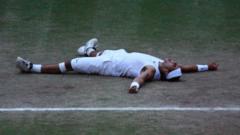
Rafael Nadal sat in the fading London light, his trousers soaked in sweat and rain, staring at the golden challenge cup. He just beat Roger Federer on grass. Think about that for a second. In 2008, Federer did not just win Wimbledon; he owned it. He possessed it like a piece of personal real estate, riding a 65-match grass-court winning streak. When Nadal choked back tears and admitted he never imagined something like this, he was not using standard athlete humility. He was genuinely stunned.
Sports writers throw the word greatest around until it loses all meaning. But the 2008 Wimbledon final resists hyperbole because the reality was wilder than any fiction. It lasted four hours and 48 minutes of actual play, spanned nearly seven hours due to chaotic British rain delays, and ended in near-pitch darkness.
If you want to understand modern tennis grit, you have to look past the trophy lift. You need to look at how a clay-court specialist completely reinvented his game to tear down a sporting empire.
The Psychological Scar of 2007
You cannot appreciate what happened in 2008 without looking at the locker room floor twelve months earlier. In 2007, Nadal pushed Federer to five sets at the All England Club. He had break points in the fifth. He blew them.
After that loss, Nadal wept uncontrollably in the dressing room. It was not a few quiet tears. It was a full-body, devastating release of grief. He felt he let his best chance slip away forever. His uncle and coach, Toni Nadal, sat with him for hours, refusing to offer cheap comfort. Toni told him the truth. He told him he played worse than Federer in the critical moments.
That brutal honesty shaped the 2008 campaign. Nadal arrived in London with an obsession. He won Roland Garros a few weeks prior, absolutely destroying Federer in a straight-sets demolition that left psychological scars on the Swiss maestro. But grass was different. Grass was Federer's living room. Nadal knew he needed more than just heavy topspin to win on lawn. He needed a complete tactical overhaul.
The Tactical Tweaks Nobody Noticed
Everyone talks about Nadal's baseline ferocity. They look at the massive biceps and the relentless running. They miss the subtle chess moves that actually won the match.
First, Nadal changed his position on the return of serve. On clay, he stood way back, almost hitting the canvas signs. On grass, he stepped up. He forced himself to take Federer's slice early, refusing to let the ball skid low and away from him.
Second, he flattened his forehand. His narrative was always about that wicked topspin bouncing over opponents' shoulders. That does not work on grass; the ball dies. Nadal intentionally struck the ball flatter, driving it through the court rather than looping it.
Flattening the Forehand
He targeted Federer’s backhand with a flatter, faster ball. It stopped Federer from stepping in and taking control with his signature inside-out forehand.
The Short Slice Defense
Federer loved dragging Nadal wide with low, biting slice shots. In previous years, Nadal scrambled and hit weak defensive lobs. In 2008, he stayed low, bent his knees to the turf, and whipped short, angled cross-court passing shots. It neutralised Federer’s net approaches completely.
Two Sets Up and the Dark Clouds Roll In
The match started like a shock to the system. Nadal came out hitting like a sledgehammer. He took the first set 6-4. Then he took the second set 6-4. The Centre Court crowd sat in stunned silence. Federer looked human. He looked hurried.
Then the weather stepped in.
Rain delays are a psychological nightmare for tennis players. You are bursting with adrenaline, your muscles are warm, and suddenly you are sitting on a couch in a locker room eating bananas and staring at a wall. For Nadal, the first delay at 4-5 in the third set was a test of mental survival.
When they came back out, Federer snatched the third set in a tiebreak. The momentum shifted. The crowd woke up. They wanted history, and they wanted a fight.
The Fourth Set Tiebreak Nightmare
The fourth set led to what remains the most dramatic tiebreak in tennis history. Nadal earned a mini-break. He had the match on his racket. He served for the championship. Then, the nerves hit.
Nadal hit a double fault. He looked tense. Still, he fought his way to a match point. He hit a forehand down the line, but Federer came up with an absurd, looping backhand passing shot from outside the doubles alley. It was a shot of pure genius.
When Federer won that tiebreak 10-8 to level the match at two sets apiece, anyone watching assumed Nadal was cooked. He had the tournament won. He let it go. History shows that when you let Federer off the hook at Wimbledon, he punishes you. Most players would have crumpled into a ball of regret right there.
Uncle Toni's Quiet Locker Room Intervention
Another rain delay hit in the fifth set at 2-2. The players retreated to the locker room again. This was the defining moment of Nadal’s career.
Toni Nadal walked over to his nephew, preparing to give a grand motivational speech. He did not need to. Rafael looked at him, totally calm, and said he would not lose. He told his uncle that even if Federer won, he would have to play at an impossible level because he was not going to give away a single unforced error.
Nadal shook off the ghost of the missed match points. He stopped dwelling on what went wrong. He focused entirely on the next ball. That is the essence of his entire career.
Playing in the Pitch Black
When they walked back out for the final stretch, night was falling. In 2008, Centre Court did not have its fancy retractable roof or stadium lighting. They relied on old-fashioned daylight. By the time the score reached 7-7 in the fifth set, the ball was becoming a yellow blur.
John McEnroe, commentating for the BBC, openly stated that they should stop play. It was dangerous. The players could barely see the spin on the ball. But both Nadal and Federer refused to stop. They wanted it finished.
At 7-7, Nadal broke Federer's serve. He did it by playing brutally aggressive tennis, moving forward and forcing Federer into hurried errors.
Serving for the match at 8-7, the darkness was comical. Flashbulbs from cameras were popping in the crowd, illuminating the court like a strobe light. Nadal got to his third match point. Federer hit a forehand into the net.
Nadal dropped to the grass, lying flat on his back, staring up at the dark London sky. He did what everyone said was impossible. He conquered the king of grass on his own turf.
Why This Win Rewrote Tennis History
Before this match, men's tennis had clean boundaries. Nadal ruled the dirt of Paris. Federer ruled the grass of London. They had their territories.
This match broke those borders down. It proved that Nadal was not just a clay court bully. It forced Federer to adapt, turning their rivalry from a standard contrast of styles into an era-defining war for greatness.
When Nadal climbed up into the players' box, walking across the commentary roof to hug his family and the Spanish Royalty, it signified a changing of the guard. He proved that defense, heart, and tactical evolution could overcome pure tennis elegance on any surface.
Your Move next Time You Face Adversity
You probably do not play on Centre Court, but the lessons from Nadal's 2008 run apply to any high-stakes scenario.
First, stop treating your past failures like a death sentence. Nadal used the agony of 2007 to fuel his physical preparation for 2008.
Second, adapt your strategy before you are forced to. Nadal did not wait until he was losing to flatten his forehand and step up on the return. He anticipated the challenge and evolved early.
Finally, lock in when things go wrong. When you lose your advantage, whether it is a business deal or a match point, you cannot afford to look back. Take a breath, reset your stance, and make your opponent win the next point through sheer force. Forget about the darkness. Just hunt the ball.


