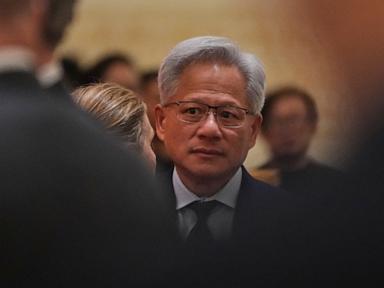
The steam rising from a bowl of zhajiangmian in a Beijing backstreet isn't supposed to feel like a geopolitical chess move. It’s just flour, water, fermented soybean paste, and a tangle of pork. But when the man holding the chopsticks is Jensen Huang, the floral-print-clad architect of the modern AI revolution, that steam carries a different weight. It smells like a peace offering.
He stood in a crowded Beijing eatery, stripped of the signature black leather jacket that has become a uniform for the silicon elite. Instead, he wore a traditional brightly colored vest, blending—or perhaps trying very hard to blend—into the rhythm of a city that sits at the center of his company’s most complex puzzle. This wasn't a boardroom in Santa Clara. There were no slide decks. No projections of TFLOPS or CUDA core efficiency. There was only a billionaire, a bowl of noodles, and the silent, vibrating tension of a bridge being built in real-time.
To understand why this meal matters, you have to look past the casual tourism of a CEO on a "food tour." You have to look at the silicon. Nvidia’s chips are the oxygen of the new world. Without them, the grand dreams of generative AI—the kind that writes poetry, diagnoses diseases, and predicts the weather—simply stop breathing. For years, China has been one of Nvidia’s biggest lungs, inhaling roughly a fifth of its data center revenue. Then, the geopolitical climate shifted. The air grew thin.
The Invisible Wall
Imagine you are a master chef. You have spent decades perfecting a secret sauce that everyone in the world wants to buy. Suddenly, your local government tells you that you can no longer sell that sauce to your biggest customer across the ocean. You can sell them a watered-down version, sure. You can give them the recipe for something simpler. But the "good stuff"—the high-octane, world-changing ingredient—is off-limits.
This is the reality Jensen Huang navigates every morning. The U.S. export controls on high-end AI chips like the H100 and the newer Blackwell architecture have turned Nvidia’s business model into a high-wire act. On one side is the American mandate to maintain a technological edge. On the other is a massive, hungry Chinese market that is already starting to look elsewhere—to domestic players like Huawei—because they are tired of being told what they can’t buy.
When Huang landed in China for his first visit in four years, he wasn't just there to see the sights. He was there to remind the people on the ground that Nvidia still speaks their language. Not just the language of code, but the language of culture.
There is a specific kind of vulnerability in a CEO performing a folk dance or slurping noodles in a public canteen. It is a performance of humanity. It says, I am still here. We are still connected. In a world of cold trade wars and hardening borders, that bowl of noodles is a middle finger to the idea of total decoupling.
The Rhythm of the Street
The noise of a Beijing noodle shop is chaotic. It is the sound of clashing porcelain, the rhythmic thud of dough being pulled, and the low hum of a hundred different conversations. It is a stark contrast to the sterile, vibration-damped clean rooms where Nvidia’s chips are born.
In those clean rooms, a single speck of dust can ruin a wafer worth tens of thousands of dollars. Precision is the only god. But on the streets of Beijing, Huang was embracing the mess. He was seen at the company’s annual lunar new year parties in Shenzhen, Shanghai, and Beijing, ditching the leather jacket for a "dongbei" floral vest and joining staff in a traditional dance.
Critics might call it a charm offensive. It was. But it was also a survival tactic.
Consider a hypothetical engineer in Shanghai named Li. For years, Li has built his career around Nvidia’s software ecosystem. He knows how to squeeze every drop of power out of a GPU using Nvidia’s proprietary tools. But now, Li is being told by his bosses that they might have to switch to Chinese-made chips to avoid future supply shocks. Li is nervous. He doesn't want to learn a new system. He wants the gold standard.
When Li sees his "Big Boss" Jensen on social media, dancing and eating the same comfort food he grew up with, the psychological bond is reinforced. It creates a sense of loyalty that a spec sheet cannot replicate. It whispers to Li that Nvidia hasn't given up on him, even if the politicians have.
The Cost of the Gap
The stakes are not just about revenue. They are about the soul of technological progress. We often talk about AI as if it is a singular, ethereal force, but it is actually a physical thing. It requires sand, light, and staggering amounts of electricity.
If the world splits into two distinct technological "realms"—one powered by Western silicon and another by Eastern alternatives—the friction will be immense. Models won't talk to each other. Innovation will slow. We will spend more time building translators between our systems than we will building the systems themselves.
Huang’s tour was a soft-power attempt to lubricate those gears. He didn't meet with high-ranking government officials in televised summits. He didn't issue grand policy statements. He went to the offices. He talked to the people who actually plug the chips into the racks. He ate the noodles.
The zhajiangmian itself is a metaphor for this complexity. It is a dish defined by its sauce—a dark, salty, fermented paste that takes time to develop. You can't rush it. You can't fake the depth of flavor that comes from aging. Nvidia’s dominance is that sauce. It’s not just the hardware; it’s the fifteen years of software development and developer trust that they’ve let ferment.
But even the best sauce loses its appeal if the restaurant doors are locked.
The Dance of the Two Giants
There is a particular kind of silence that follows a loud party. After the dancing stopped and the floral vests were packed away, the reality remained. Nvidia is currently shipping "compliant" chips to China—versions of their hardware that have been slowed down just enough to satisfy U.S. regulators while remaining useful enough to satisfy Chinese buyers.
It is a compromise that pleases almost no one. The U.S. worries it’s still too much power; the Chinese worry it’s not enough.
In this environment, Huang acts as a bridge. He is a man born in Taiwan, educated in the U.S., leading a global empire, and trying to keep a foothold in the mainland. He is the personification of the globalized world that many fear is dying.
Watching him navigate the crowds in Beijing, you realize that the most important technology in the room wasn't the H100. It was the ability to sit across a table and share a meal. We have reached a point where our machines are becoming so fast and so powerful that we have forgotten the slow, human work required to keep the world together.
The chips will continue to get smaller. The neural networks will continue to get deeper. The "moats" around companies will grow wider. But at the end of the day, the billion-dollar contracts and the fate of global AI still hinge on the same thing they did a thousand years ago: the trust established between people over a bowl of food.
Jensen Huang knows that you can't optimize trust with an algorithm. You have to show up. You have to dance. You have to eat. You have to be willing to get a little bit of sauce on your shirt.
The steam from the noodles eventually disappears into the cold Beijing air. The crowds disperse. The CEO heads back to the airport, and the engineers go back to their screens. The invisible wall is still there, but for a moment, it felt a little thinner. The chips are cold, hard objects, but the hands that build them are warm, and they are still reaching out.
In the high-stakes game of silicon supremacy, the boldest move isn't a new architecture or a faster clock speed. It’s the simple, defiant act of being a human being in a place where people expect you to be a machine.